Masakazu Ejiri
Also known as 江尻正員
Masakazu Ejiri is a Japanese engineer who spent his career at Hitachi's Central Research Laboratory, from 1959 to 2003, building vision-based machines for factory and office automation. In 1970, his team demonstrated a prototype intelligent robot that read an assembly drawing, recognized blocks on a table and planned how to build the object. A fully automatic transistor assembly system based on multiple local pattern matching followed in 1973, and its technology spread through the worldwide semiconductor industry. He served as IAPR vice-president from 1990 to 1992, became an IAPR Fellow in 1996, presided over the Robotics Society of Japan from 2001 to 2003 and received the Engelberger Award from the Robotics Industries Association in 2005. By 2012, he had largely retired near Tsukuba and worked as an independent R&D consultant in industrial science.
Timeline
-
1959–1968
Osaka, Hitachi and Chicago
He earns a B.E. in mechanical engineering at Osaka University and joins Hitachi's Central Research Laboratory in Tokyo in 1959, working on automatic assembly machines for transistors. After a Dr. Eng. in electrical engineering from Osaka in 1967, he spends 1967–1968 as a visiting professor at the University of Illinois, studying physiological vision systems at its Biomedical Department in Chicago.
-
1970–1972
A robot that reads drawings
In 1970, he and Hitachi colleagues build a vision-based prototype intelligent robot that reads an assembly drawing, recognizes blocks placed on a table, plans the assembly by backward reasoning and builds the object. Hitachi shows the robot at its Technology Fair in 1970, and the team describes it at IJCAI in 1971 and in IEEE Transactions on Computers in February 1972.
-
1973–1976
Automatic transistor assembly
His team puts a vision-based, fully automatic transistor assembly system into use in 1973; it finds electrode positions on chips 0.4 to 0.6 mm square with multiple local pattern matching, and one computer controls up to 50 machines. The technology spreads to IC and LSI assembly and wins a Technology Award from the Japan Society for Promotion of Machine Industry in 1975. Japan's Minister of Science and Technology gives him the Distinguished Researcher Award in 1976.
-
1977–1989
HISL and a machine vision book
From 1977 to 1981, he is vice-president of HISL Inc., a Hitachi subsidiary in California. Back in Japan, he heads projects that include a meteorological satellite image analysis system, a geographic information system, automatic teller machines and automatic letter sorting machines, and he gives an invited talk on map and drawing recognition at ICPR 1984 in Montreal. Gordon and Breach publishes his book Machine Vision: A Practical Technology for Advanced Image Processing in 1989.
-
1990–2002
IAPR vice-president and fellow
Appointed IAPR vice-president at ICPR 1990 in Atlantic City, he serves from 1990 to 1992 and proposes the Best Industry-Related Paper Award and the IAPR Fellowship Program. He sits on the IAPR Governing Board from 1992 to 2002, and IAPR names him a Fellow at ICPR 1996 in Vienna for contributions to the development of machine vision technology and for outstanding service to IAPR.
-
2000–2003
Robotics Society of Japan president
At the IAPR Workshop on Machine Vision Applications at the University of Tokyo in November 2000, he gives the invited talk Evolution of Real-Time Image Processing in Practical Applications. From 2001 to 2003, he is president of the Robotics Society of Japan, and he retires from Hitachi in 2003 as Senior Chief Research Scientist, Corporate Technology.
-
2005–2008
The Engelberger Award
The Robotics Industries Association gives him the Joseph F. Engelberger Award in 2005. From 2005 to 2008, he is vice-president of the Trans-disciplinary Federation of Science and Technology, an alliance of Japanese academic societies that he helps found. In 2008, he is general co-chair of ICPR in Tampa, and the Robotics Society of Japan names him its honorary president.
-
By 2012
Consultant near Tsukuba
By 2012, he works as an independent R&D consultant in industrial science and has largely retired to the countryside near Tsukuba. He serves on the Advisory Committee of ICPR 2012 in Tsukuba.
Career
- 2005–2008Trans-disciplinary Federation of Science and TechnologyCo-founder, Vice-president
- 2001–2003Robotics Society of JapanPresident, Honorary President
- 1990–2002International Association for Pattern RecognitionVice-president, Member, Governing Board
- 1967–1968University of Illinois Urbana-ChampaignVisiting Professor
- 1959–2003HitachiVice-president, Senior Chief Research Scientist
Education
- 1967Osaka UniversityB.E.
Colleagues
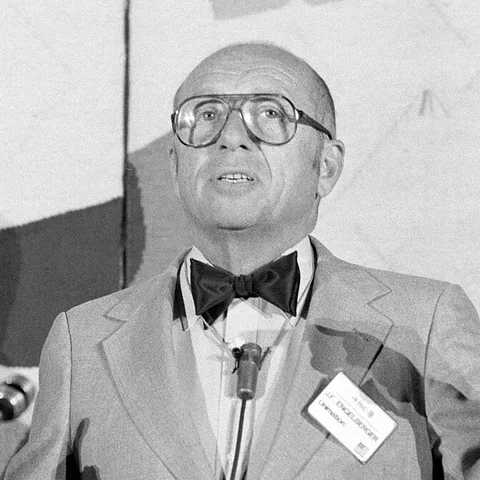 Joseph F. EngelbergerNamed in this biography
- Walter G. KropatschInternational Association for Pattern Recognition, 1992–2002
- Yasuaki NakanoHitachi, 1963–1967
- Réjean PlamondonInternational Association for Pattern Recognition, 1994–1998
- Gabriella Sanniti di BajaInternational Association for Pattern Recognition, 1994–2000
- Hiromichi FujisawaHitachi, 1977–1981
Sources and credits
Photo: We have no published photo of Masakazu Ejiri yet. Send us a free-licensed photo.
- Get to Know Ejiri
- Intelligent Robot|ロボ學 - ROBOGAKU
- An Intelligent Robot with Cognition and Decision-Making Ability | ML Anthology
- Transistor Assembly System|ロボ學 - ROBOGAKU
- CiNii 図書 - Machine vision : a practical technology for advanced image processing
- Chronological List of IAPR Fellows – International Association for Pattern Recognition
- MVA2000 Advance Program