Chris H. Q. Ding
Also known as C. Ding, C. H. Q. Ding, C.H.Q. Ding, CHRIS DING, 丁宏强
Chris Ding is a researcher whose work spans machine learning, data mining, bioinformatics and web link analysis. He studied computer science at Anhui University and Columbia, then worked at Caltech, NASA's Jet Propulsion Laboratory and Lawrence Berkeley National Laboratory before becoming a professor at the University of Texas at Arlington. His work linked PageRank and HITS to web structure, related nonnegative matrix factorization to K-means clustering, and applied mRMR to microarray gene selection; he also introduced the L21 norm. JPL, ICMLA and UT Arlington recognized work from his career with awards in 1996, 2006 and 2014. As of October 2026, he is a Presidential Chair Professor in the School of Data Science at CUHK (Shenzhen).
- Works
- 364
- Citations
- 27,819
- h-index
- 70
- Badges
Publication numbers from OpenAlex, as of 22 October 2026.
Timeline
-
1977–1987
Anhui and Columbia degrees
He earns a B.S. in computer science at Anhui University in 1981, then completes an M.A., M.Phil. and Ph.D. at Columbia by 1987. At Columbia, he helps build a parallel computer that appears on a Science cover.
-
1987–1996
Caltech and JPL computing
From 1987 to 1993, he works at Caltech, where he studies high-temperature superconductors with Monte Carlo simulations. He joins NASA's Jet Propulsion Laboratory in 1993, develops algorithms for climate data assimilation, sparse matrix solvers and parallel graph partitioning, and receives a NASA Group Achievement Award from JPL in 1996.
-
1996–2007
PageRank and web ranking
At Lawrence Berkeley National Laboratory from 1996 to 2007, he and collaborators show that PageRank is essentially a ranking by link in-degree. In 2002, he and four coauthors publish a framework that combines PageRank and HITS.
-
2005
NMF and K-means clustering
In 2005, he, Xiaofeng He and Horst D. Simon show that nonnegative matrix factorization is equivalent to K-means clustering.
-
2005
mRMR gene selection
With Hanchuan Peng, he publishes a 2005 paper applying minimum redundancy maximum relevance feature selection to microarray gene data.
-
2006
The L21 norm
He proposes the L21 matrix norm in 2006, a measure used across AI, machine learning, computer vision and computational biology. His coauthored supernova-recognition paper wins ICMLA's Best Application Paper Award in 2006.
-
2007–2020
Professor at UT Arlington
He serves as a professor in UT Arlington's Department of Computer Science and Engineering from 2007 to 2020. He receives UT Arlington's Outstanding Research Award in 2014.
-
As of October 2026
Presidential Chair Professor
As of October 2026, he is a Presidential Chair Professor in the School of Data Science at CUHK (Shenzhen). His research spans machine learning, data mining, bioinformatics, information retrieval, web link analysis and high-performance computing.
Career
- Since 2021Chinese University of Hong Kong, ShenzhenPresidential Chair Professor
- 2022–2026Chinese University of Hong Kong
- 2011–2017Anhui University
- 2007–2020University of Texas at ArlingtonProfessor
- 1998–2007University of California, Berkeley
- 1996–2007Office of Science
- 1993–1996NASA
- 1987–1993California Institute of Technology
Education
- 1987Columbia UniversityM.A., M.Phil. and Ph.D.
- 1981Anhui UniversityB.S. in computer science
Colleagues
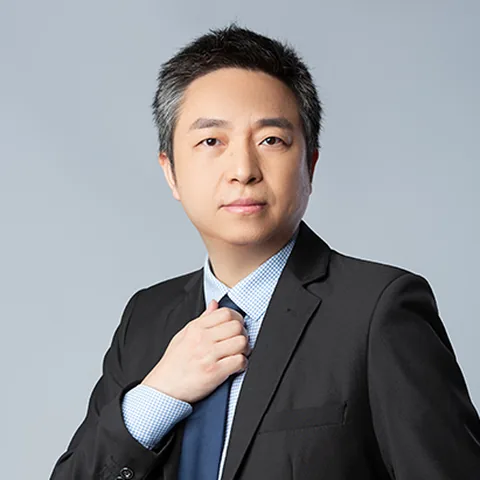



Sources and credits
Photo: We have no published photo of Chris H. Q. Ding yet. Send us a free-licensed photo.