Sertac Karaman
Sertac Karaman is a roboticist and MIT professor whose research connects motion planning, autonomous vehicles and AI. He earned engineering degrees at Istanbul Technical University and MIT, joined MIT’s DARPA Urban Challenge team in 2007, and completed a doctorate at MIT in 2012. He coauthored RRT*, received the AIAA Orville and Wilbur Wright Graduate Award and the IEEE Robotics and Automation Society Early Career Award, and gained tenure at MIT in 2019. He co-founded self-driving company Optimus Ride in 2015 and rose through MIT’s AeroAstro faculty ranks while discussing autonomous systems on Lex Fridman’s podcast in 2020. In 2025, he coauthored a paper on open Air Force AI challenges; he is a professor of aeronautics and astronautics, director of LIDS, and co-director of LEAN.
- Works
- 305
- Citations
- 19,382
- h-index
- 58
Publication numbers from OpenAlex, as of 22 October 2026.
Timeline
-
2007–2009
Degrees and the Urban Challenge
In 2007, he earns bachelor’s degrees in mechanical and computer engineering at Istanbul Technical University and joins MIT’s DARPA Urban Challenge team with Albert Huang; MIT’s vehicle is one of six to complete the 60-mile course. He earns an S.M. in mechanical engineering at MIT in 2009.
-
2011
RRT* and an AIAA award
In 2011, he coauthors “Sampling-based Algorithms for Optimal Motion Planning” with Emilio Frazzoli; the paper introduces PRM* and RRT*, algorithms that are provably asymptotically optimal. He receives the AIAA Orville and Wilbur Wright Graduate Award for exceptional aerospace research.
-
2012
An MIT PhD and faculty post
He completes a PhD in electrical engineering and computer science at MIT and joins its Department of Aeronautics and Astronautics as a Charles Stark Draper Assistant Professor in September 2012.
-
2015–2023
Optimus Ride and MIT faculty
In August 2015, he co-founds Optimus Ride, a self-driving vehicle company. He becomes an associate professor in MIT AeroAstro in 2016 and discusses autonomous flying, driving, simulation and game theory on Lex Fridman’s podcast in May 2020. MIT names him professor of aeronautics and astronautics in July 2023.
-
2017
An IEEE robotics award
In 2017, he receives the IEEE Robotics and Automation Society Early Career Award for contributions to motion planning and control algorithms for robots and autonomous vehicles.
-
June 2019
Tenure at MIT
In June 2019, MIT grants him tenure as an associate professor in Aeronautics and Astronautics.
-
October 2025
A paper on Air Force AI
In October 2025, he coauthors “Advancing AI Challenges for the United States Department of the Air Force.” The paper describes public AI challenges, AI-ready datasets for open-source research, and progress in advancing AI research and applications.
-
As of October 2026
MIT professor and lab director
He takes over as director of MIT’s Laboratory for Information and Decision Systems in 2021 and becomes professor of aeronautics and astronautics in July 2023. As of October 2026, he co-directs LEAN with Vivienne Sze; the group co-designs algorithms and computing hardware for low-energy autonomous vehicles.
Career
- Since 2016Massachusetts Institute of TechnologyCharles Stark Draper Assistant Professor, Associate Professor
- From 2015Optimus RideCo-founder
- 2014–2016MIT CSAIL
Education
- 2012Massachusetts Institute of TechnologyS.M. in mechanical engineering
- 2007Istanbul Technical UniversityBachelor's degrees in mechanical and computer engineering
Most-cited works
- Sampling-based algorithms for optimal motion planning
- Anytime Motion Planning using the RRTWith Seth Teller
- Real-Time Motion Planning With Applications to Autonomous Urban DrivingWith Jonathan P. How
- Incremental Sampling-based Algorithms for Optimal Motion Planning
- Sparse-to-Dense: Depth Prediction from Sparse Depth Samples and a Single Image
Videos
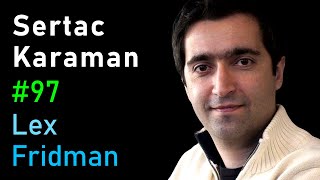 Sertac Karaman: Robots That Fly and Robots That Drive | Lex Fridman Podcast #97Lex Fridman · 20 May 2020 · 1 h 23 min
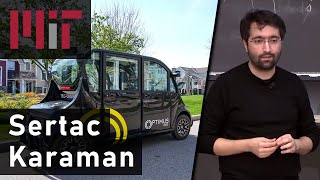 Sertac Karaman (MIT) on Motion Planning in a Complex World - MIT Self-Driving CarsLex Fridman · 13 December 2017 · 1 h 2 min
Video data from YouTube API Services. By watching you agree to the YouTube Terms of Service. How we use YouTube data.
Colleagues

Sources and credits
Photo: We have no published photo of Sertac Karaman yet. Send us a free-licensed photo.
- Home
- Optimus Ride’s autonomous system makes self-driving vehicles a reality
- [1105.1186] Sampling-based Algorithms for Optimal Motion Planning
- MIT AeroAstro News September 2012
- Sertac Karaman - MIT AeroAstro
- #97 - Sertac Karaman: Robots That Fly and Robots That Drive | Lex Fridman Podcast
- 2017 RAS Award Recipients Announced - IEEE Robotics and Automation Society Website
- Saurabh Amin and Sertac Karaman awarded tenure – IDSS
- [2511.00267] Advancing AI Challenges for the United States Department of the Air Force
- History | MIT LIDS
- Low-Energy Autonomy and Navigation (LEAN) Research Group