Phil Woodland
Also known as Philip C. Woodland, Philip Charles Woodland
Phil Woodland is a professor of information engineering at the University of Cambridge whose group developed techniques that are now common in large-vocabulary speech recognition. After three years at British Telecom Research Labs, he returned to Cambridge in 1989, and the research on transform-based adaptation he started in 1993 led to Maximum Likelihood Linear Regression. He is one of the original coauthors of the HTK toolkit, and Cambridge systems built on it frequently had the lowest error rate in NIST evaluations between 1994 and 2004. Cambridge made him a full professor in 2002, and he became an IEEE Fellow in 2013 and a Fellow of the Royal Academy of Engineering in 2017. He heads the Machine Intelligence Laboratory in the Department of Engineering, where his current work focuses on end-to-end trainable neural network systems.
Timeline
-
1989
A lectureship at Cambridge
After three years at British Telecom Research Labs, he returns to a lectureship at the University of Cambridge in 1989.
-
1993–2000
Speaker adaptation with MLLR
He starts research on transform-based adaptation for speech recognition in 1993 at the University of Cambridge's Department of Engineering, which leads to Maximum Likelihood Linear Regression (MLLR). When Computer Speech and Language introduces a best-paper award in 2000, it goes to the 1995 MLLR paper by Leggetter and Woodland.
-
1994–2004
HTK systems in NIST evaluations
He is one of the original coauthors of the HTK toolkit and keeps a major role in its development. Cambridge systems built on HTK frequently have the lowest error rate in NIST evaluations: on newspaper dictation in 1994 and 1995, on broadcast news in 1997, 2003 and 2004, and on conversational telephone speech in 1998, 2000, 2001 and 2002.
-
1999–2002
Professor and Switchboard results
He becomes a Reader in 1999 and a full Professor in 2002. In the NIST Switchboard evaluation of April 2002, the Cambridge CU-HTK system, described in a paper by Woodland, Gunnar Evermann, Mark Gales, Dan Povey and others, uses Minimum Phone Error training and reaches a 23.9% word error rate, the lowest by a statistically significant margin.
-
2011–2016
Natural Speech Technology programme
From 2011 to 2016, he is the lead Cambridge investigator on the EPSRC programme grant Natural Speech Technology, a £6.2 million collaboration with the Universities of Edinburgh and Sheffield. The project builds speech systems that adapt automatically to particular speakers and learn from their mistakes.
-
2013
An IEEE Fellowship
The IEEE names him a Fellow in 2013 for contributions to large vocabulary speech recognition.
-
2017
Royal Academy of Engineering Fellow
In 2017, the Royal Academy of Engineering elects him a Fellow; his contributions include a technique for adapting recognisers automatically to different speakers and a framework for discriminatively training acoustic models to minimise errors.
-
As of October 2026
Head of Machine Intelligence Laboratory
He is Professor of Information Engineering at the University of Cambridge, head of its Machine Intelligence Laboratory and of the Speech Research Group, and a Professorial Fellow of Peterhouse. His current work focuses on end-to-end trainable neural network systems, following earlier work on deep neural networks for both acoustic models and language models.
Career
- Since 1989University of CambridgeLecturer
- NowDepartment of Engineering, University of CambridgeHead
- Until 1989British Telecom Research Laboratories
Most-cited works
- Maximum likelihood linear regression for speaker adaptation of continuous density hidden Markov models
- Tree-based state tying for high accuracy acoustic modelling
- Minimum Phone Error and I-smoothing for improved discriminative trainingWith Daniel Povey
- Mean and variance adaptation within the MLLR frameworkWith Mark Gales
- Large scale discriminative training of hidden Markov models for speech recognitionWith Daniel Povey
Colleagues

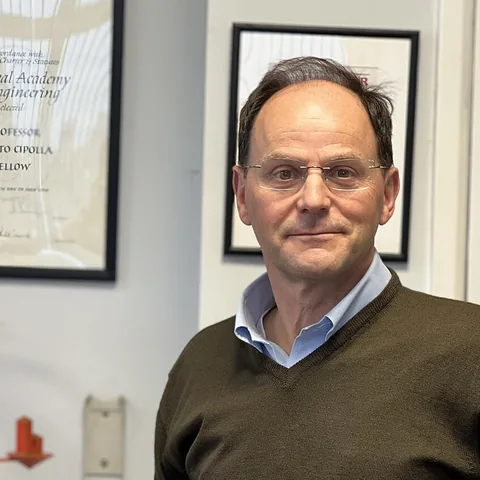
Sources and credits
Photo: We have no published photo of Phil Woodland yet. Send us a free-licensed photo.
- Phil Woodland | Department of Engineering
- Speech technology (REF2014 impact case study, University of Cambridge)
- Abstract for woodland_rt02
- Smart listeners and smooth talkers | Department of Engineering
- Phil Woodland - Centre for Science and Policy
- Philip Charles Woodland - Wikipedia
- Professor Phil Woodland elected Fellow of Royal Academy of Engineering | Cambridge Language Sciences