Miguel Hernández-Lobato
Also known as José Miguel Hernández-Lobato
Miguel Hernández-Lobato is a professor of machine learning at the University of Cambridge whose research in probabilistic methods runs from Bayesian optimization to the design of new molecules. After a computer science PhD at Universidad Autónoma de Madrid in 2010, he did postdoctoral research with Zoubin Ghahramani at Cambridge and with Ryan Adams at Harvard, and he coauthored Predictive Entropy Search in 2014, probabilistic backpropagation in 2015 and a 2018 paper on a continuous representation of molecules. He joined the Cambridge faculty as a University Lecturer in 2016 and won a Turing AI Acceleration Fellowship in 2020 for machine learning for molecular design. In 2023, ELLIS accepted Machine Learning for Molecule Discovery as a research program that he helped coordinate. Since October 2025, he is Full Professor of Machine Learning at Cambridge, where he also directs the Cambridge ELLIS unit, and he is Head of Research at Boltzbit and Chief AI Officer at Angstrom AI.
- Now at
- University of Cambridge, European Laboratory for Learning and Intelligent Systems, Boltzbit Limited and Angstrom AI
- Works
- 228
- Citations
- 8,395
- h-index
- 40
Publication numbers from OpenAlex, as of 22 October 2026.
Timeline
-
2004–2010
Computer science in Madrid
He earns a B.Sc. in Computer Science at Universidad Autónoma de Madrid in 2004, with a special prize for the best academic record on graduation, and an M.Phil. in 2007. He completes his PhD there in 2010 with a dissertation on semi-parametric methods and sparse linear models, advised by Alberto Suárez González.
-
2011–2016
Postdoc at Cambridge and Harvard
From 2011 to 2014, he is a postdoctoral researcher in Zoubin Ghahramani's Machine Learning Group at Cambridge. From 2014 to 2016, he is a postdoctoral fellow in Ryan Adams's Harvard Intelligent Probabilistic Systems group, funded by a Rafael del Pino Foundation fellowship.
-
2014–2015
Entropy search and probabilistic backpropagation
In 2014, he coauthors Predictive Entropy Search, a Bayesian optimization method that picks the next point to evaluate by its expected information gain about the global maximum. In 2015, he and Ryan P. Adams present probabilistic backpropagation, a scalable way to learn Bayesian neural networks by propagating probabilities forward through the network and gradients backward.
-
2016–2022
Lecturer to professor at Cambridge
Cambridge's Machine Learning Group announces in April 2016 that he will join as University Lecturer in Machine Learning, and he starts in the Department of Engineering in September 2016. He becomes Associate Professor in October 2021 and Professor of Machine Learning in October 2022.
-
2018
A continuous representation of molecules
In 2018, he coauthors an ACS Central Science paper with Rafael Gómez-Bombarelli, Alán Aspuru-Guzik and others, in which a neural network turns molecules into continuous vectors. The continuous representation lets gradient-based optimization guide the search for better molecules.
-
2020
Turing fellowship and ELLIS unit
He becomes director of the Cambridge ELLIS unit in September 2020. In November 2020, he is awarded a Turing AI Acceleration Fellowship for machine learning for molecular design, aimed at generative models that place atoms in 3D space and provide synthesis information.
-
2023
An ELLIS program on molecules
ELLIS accepts Machine Learning for Molecule Discovery as a new ELLIS Program in 2023. He coordinates the proposal with Günter Klambauer of Johannes Kepler University Linz and Nadine Schneider of Novartis, and ELLIS lists him as its Program Director.
-
Since October 2025
Full professor and industry roles
He becomes Full Professor of Machine Learning in the Department of Engineering at Cambridge in October 2025 and continues as director of the Cambridge ELLIS unit. He is Head of Research at Boltzbit Limited since September 2025 and Chief AI Officer at Angstrom AI since November 2024.
Career
- Since 2025Boltzbit LimitedHead of Research
- Since 2024Angstrom AIChief AI Officer
- Since 2020European Laboratory for Learning and Intelligent SystemsDirector
- Since 2011University of CambridgePostdoctoral researcher, University Lecturer in Machine Learning
- 2018–2020Alan Turing Institute
- 2014–2016Harvard UniversityPostdoctoral fellow
- 2006–2011Universidad Autónoma de Madrid
Education
- 2010Autonomous University of MadridPhD
- 2007Autonomous University of MadridM.Phil.
- 2004Autonomous University of MadridB.Sc. in Computer Science
Most-cited works
- Automatic Chemical Design Using a Data-Driven Continuous Representation of MoleculesWith David Duvenaud
- Probabilistic Backpropagation for Scalable Learning of Bayesian Neural Networks
- Minerva
- Predictive Entropy Search for Efficient Global Optimization of Black-box FunctionsWith Zoubin Ghahramani
- Grammar Variational Autoencoder
Videos
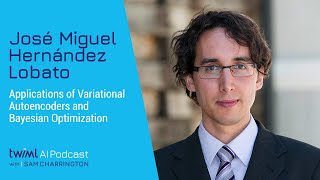
Video data from YouTube API Services. By watching you agree to the YouTube Terms of Service. How we use YouTube data.
Colleagues

Sources and credits
Photo: We have no published photo of Miguel Hernández-Lobato yet. Send us a free-licensed photo.
- Computational and Biological Learning Lab: José Miguel Hernández-Lobato
- José Miguel Hernández-Lobato - The Mathematics Genealogy Project
- José Miguel Hernández-Lobato
- Predictive Entropy Search for Efficient Global Optimization of Black-box Functions
- Probabilistic Backpropagation for Scalable Learning of Bayesian Neural Networks
- New faculty member Dr. José Miguel Hernández-Lobato – MLG Cambridge
- Automatic Chemical Design Using a Data-Driven Continuous Representation of Molecules - Princeton University
- Cambridge machine learning experts announced as Turing AI Fellows
- Turing Artificial Intelligence Fellowships
- ELLIS Research Programs: Two new proposals accepted
- Miguel Hernández-Lobato | European Laboratory for Learning and Intelligent Systems