Zoubin Ghahramani
Zoubin Ghahramani is a machine-learning researcher and Google DeepMind research leader whose work spans Bayesian methods and AI for data analysis. His early childhood was spent in the former Soviet Union and Iran; he earned cognitive science and computer science degrees at Pennsylvania and a cognitive neuroscience PhD at MIT. At Cambridge, he led the Automatic Statistician, which searches statistical models and writes reports about data; his paper Lost Relatives of the Gumbel Trick received an ICML 2017 Best Paper honorable mention. He became a Royal Society Fellow in 2015 and led AI research at Uber; as of October 2026, he is Google DeepMind's Vice President of Research and an ELLIS Fellow.
- Now at
- University of Cambridge and Google DeepMind
- Works
- 454
- Citations
- 73,278
- h-index
- 94
Publication numbers from OpenAlex, as of 14 October 2026.
Timeline
-
Before 1990
A childhood across borders
His early childhood was spent in the former Soviet Union and Iran.
-
1990–1995
Degrees in mind and computing
He earned a BA in cognitive science and a BSEng in computer science and engineering at the University of Pennsylvania in 1990, then completed a cognitive neuroscience PhD at MIT in 1995.
-
1995–2012
A career across research centers
After a Toronto postdoctoral fellowship with Geoff Hinton from 1995 to 1998, he joined UCL's Gatsby Computational Neuroscience Unit as one of its founding faculty members from 1998 to 2005. From 2002 to 2012, he held an associate research professorship in Carnegie Mellon's Machine Learning Department. In 2006, he moved to Cambridge as Professor of Information Engineering.
-
2014
Automating statistical explanations
At Cambridge, he led the Automatic Statistician project, which searches possible statistical models to explain data and generates a report with figures and natural-language text. Google gave the project a $750,000 Focused Research Award.
-
2015–2017
Awards and an industry lab
The Royal Society elected him a Fellow in 2015, citing contributions to probabilistic modeling, Bayesian nonparametrics and approximate variational inference. In 2017, he became Uber's Chief Scientist and oversaw its AI and ML strategy and Uber AI Labs. He coauthored Lost Relatives of the Gumbel Trick with Matej Balog, Nilesh Tripuraneni and Adrian Weller; the paper received an ICML 2017 Best Paper honorable mention.
-
2021
Training AI for changing data
He became one of the first Turing AI World-Leading Researcher Fellows. His project aimed to develop algorithms that help AI systems adapt to new data and use prior knowledge and symbolic reasoning.
-
April 2023
Joining Google DeepMind
In April 2023, he joined Google DeepMind's research leadership team, reporting to Koray Kavukcuoglu.
-
As of October 2026
Leading research at DeepMind
He is Vice President of Research at Google DeepMind and Professor of Information Engineering at Cambridge. He is also an ELLIS Fellow.
Sources and credits
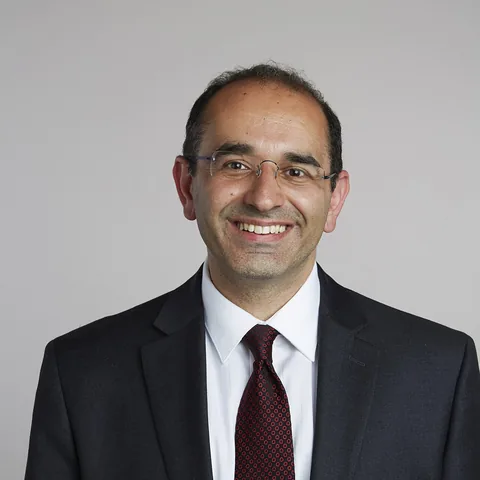
Photo: Royal Society uploader, via Wikimedia Commons. License: CC BY-SA 4.0. Source: commons.wikimedia.org. Cropped to a square and resized. Ask us to remove or replace this photo.

- Zoubin Ghahramani Bio
- Zoubin Ghahramani – MLG Cambridge
- Google Award for the Automatic Statistician
- Professor Zoubin Ghahramani elected Fellow of the Royal Society – MLG Cambridge
- New role for Cambridge AI and machine learning expert
- ICML 2017 Awards
- Professor Zoubin Ghahramani announced as a Turing AI World-Leading Researcher Fellow
- Announcing Google DeepMind
- Professor Zoubin Ghahramani FRS
- Zoubin Ghahramani | European Laboratory for Learning and Intelligent Systems