Mark Coates
Mark Coates is an AI researcher whose work includes network tomography, distributed particle filtering and learning on graphs. He earned a computer systems engineering degree at Adelaide in 1995 and a PhD in information engineering at Cambridge in 1999, then worked as a research associate and lecturer at Rice through 2001. He joined McGill's electrical and computer engineering department in 2002; his research team received the NSERC Synergy Award in 2006, and he worked as a senior scientist at Winton Capital in 2012–2013. His later coauthored work applied machine learning to biological sequence design in 2023 and Koopman-based recurrent networks for time-series forecasting in 2025. As of October 2026, he is an associate professor in McGill's Department of Electrical and Computer Engineering and supervises the McGill Networks Research Lab.
- Now at
- McGill University
Timeline
-
1995–1999
Adelaide engineering and Cambridge PhD
He earns a B.E. in computer systems engineering from the University of Adelaide in 1995 and a PhD in information engineering from the University of Cambridge in 1999.
-
1999–2001
Research at Rice
At Rice University, he works as a research associate and lecturer from 1999 to 2001.
-
2002
Joining McGill ECE
He joins McGill's Department of Electrical and Computer Engineering in 2002.
-
2006
An NSERC Synergy Award
His research team receives the 2006 NSERC Synergy Award for its collaboration with Canadian industry.
-
2012–2013
Senior scientist at Winton
He works as a senior scientist at Winton Capital Management in Oxford in 2012–2013.
-
2023
Biological sequence design
In 2023, he coauthors 'Bidirectional Learning for Offline Model-based Biological Sequence Design.' The method adds a linear head to a pre-trained language model and proposes a linearization scheme for offline model-based sequence optimization.
-
2025
SKOLR for time-series forecasting
In 2025, he coauthors SKOLR, which connects Koopman operator approximation with linear recurrent network updates for time-series forecasting. It uses a learnable spectral decomposition and an MLP in a parallel linear RNN stack.
-
As of October 2026
McGill associate professor and lab supervisor
As of October 2026, he is an associate professor in McGill's Department of Electrical and Computer Engineering. He supervises the McGill Networks Research Lab, and his work includes network tomography, distributed particle filtering and learning on graphs.
Career
- Since 2002McGill UniversityAssociate Professor
- 2012–2013Winton Capital ManagementSenior Scientist
- 1999–2001Rice UniversityResearch associate and lecturer
Education
- 1999University of CambridgePhD
- 1995University of AdelaideB.E.
Colleagues
Sources and credits
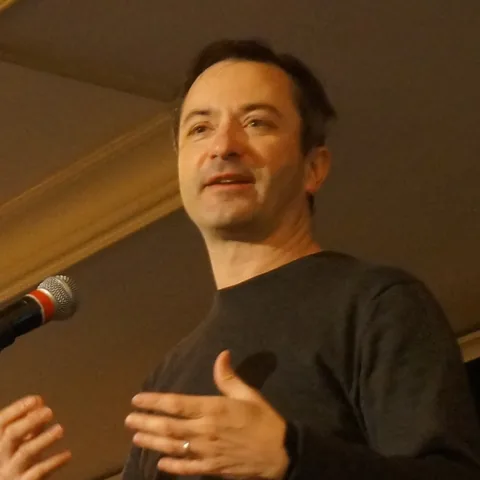
Photo: We have no published photo of Mark Coates yet. Send us a free-licensed photo.