Kevin Lenzo
Also known as Kevin A. Lenzo
Kevin Lenzo is a computer scientist whose speech technology work runs from Carnegie Mellon's FestVox and Flite toolkits to the speech lab at Duolingo. In 2000, he released the Sphinx 2 speech recognizer as open source and co-founded the speech synthesis company Cepstral with Alan W. Black; his own voice is the basis of the Flite, FreeTTS and cmu_us_kal_diphone synthetic voices. In the Perl community, he wrote the first Infobot in 1995, organized the first YAPC in 1999, received a 1999 White Camel Award and served The Perl Foundation as founding President and then Chairman until 2007. At Duolingo, he works in AI and machine learning research; as Speech Lab Lead in 2023, he oversaw speech recognition and synthesis for the app's speaking and listening exercises.
Timeline
-
1995–1996
The first Infobot
Born in 1967, he writes the first Infobot in 1995, a Perl IRC bot that remembers URLs and runs in #macintosh on EFnet under the nickname 'url'. By 1996, he keeps a comprehensive list of Macintosh speech applications at Carnegie Mellon.
-
1999
The first YAPC and a White Camel
He conceives and coordinates the first Yet Another Perl Conference at Carnegie Mellon in 1999, a grassroots meeting at $60 per person that draws nearly 300 people. He receives a 1999 White Camel Award along with Tom Christiansen and Adam Turoff.
-
1999–2014
FestVox and Building Synthetic Voices
With Alan W. Black at Carnegie Mellon's Language Technologies Institute, he writes Building Synthetic Voices, a tutorial copyrighted from 1999 to 2014. The guide accompanies FestVox, their suite of tools for building new voices for the Festival speech synthesis system.
-
2000
Open-sourcing Sphinx and founding Cepstral
In 2000, he releases the Sphinx 2 speech recognizer, originally developed by Xuedong Huang at Carnegie Mellon, as open source under a BSD-style license on SourceForge at LinuxWorld. In June 2000, he co-founds Cepstral, a Pittsburgh speech synthesis company, with Alan W. Black and other Carnegie Mellon scientists.
-
2001
Flite and the kal voice
In 2001, he and Alan W. Black publish Flite at the 4th ISCA Workshop on Speech Synthesis, a small, fast run-time synthesis library for embedded systems and servers. He helps design the voice distributed with Flite and is its speaker; his voice also underlies FreeTTS and the cmu_us_kal_diphone Festival voice.
-
2007
Perl Foundation Director Emeritus
In 2007, he leaves the voting board of The Perl Foundation, which he founded and served as founding President and then Chairman, and keeps the title of Director Emeritus.
-
2008–2013
An Apple text-to-speech patent
He is one of four inventors, with Kim Silverman, Devang Naik and Caroline Henton, on an Apple patent application filed in 2008 for synthesizing speech from text strings tied to media assets, detecting each string's native language to produce human-sounding speech. The patent is granted in 2013.
-
As of October 2026
Speech and AI at Duolingo
As Speech Lab Lead at Duolingo in February 2023, he leads the team that keeps speech recognition and synthesis working across languages for speaking and listening exercises, and describes building custom neural voices for the app's characters with Microsoft. He works in Duolingo Research's AI and machine learning group.
Career
- Since 2023DuolingoSpeech Lab Lead
- 2007The Perl FoundationFounder, founding President, then Chairman, Director Emeritus
- From 2000CepstralCo-founder
Colleagues
Sources and credits
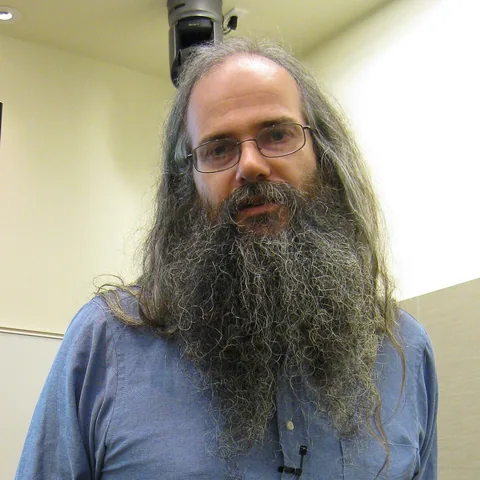
Photo: We have no published photo of Kevin Lenzo yet. Send us a free-licensed photo.
- Kevin Lenzo - Wikipedia
- Infobot - Wikipedia
- Macintosh Speech Output Applications
- Dispatch from YAPC
- White Camel Awards - www.perl.org
- Building Synthetic Voices
- Festival Speech Synthesis System - Wikipedia
- CMU Sphinx - Wikipedia
- Cepstral (company) - Wikipedia
- Flite: a small fast run-time synthesis engine
- Flite: a small, fast speech synthesis engine: 3 Acknowledgements
- Perl Foundation Board of Directors election, new people, new positions
- US8583418B2 - Systems and methods of detecting language and natural language strings for text to speech synthesis - Google Patents
- Duolingo makes learning language fun with help from AI — #LaunchWithAI - Microsoft for Startups Blog
- Research - Duolingo