Jonas Kubilius
Also known as qbilius
Jonas Kubilius is a scientist who built deep neural networks modeled on the primate visual system before moving into genome editing. After a BSc in mathematics and physics at MIT, he earned an MSc and PhD in artificial intelligence and psychology at KU Leuven, and in 2016 he showed that deep networks trained for object recognition develop sensitivity to shape features characteristic of human vision. As a Marie Skłodowska-Curie postdoctoral fellow at MIT, he and Martin Schrimpf led work on the Brain-Score benchmark and CORnet-S, a shallow recurrent network presented as an oral at NeurIPS 2019. Outside academia, he co-founded the AI solutions firm Three Thirds, which he led as CEO from 2019 to 2024, and developed the Swamp Intelligence AI installations with Nomeda and Gediminas Urbonas. Since 2024, he is a scientist in residence in Stephen Jones's genome editing lab at the EMBL Partnership Institute of Vilnius University's Life Sciences Center.
Timeline
-
2005–2012
Visual cortex at MIT and Leuven
He earns a BSc in mathematics and physics at MIT and an MSc and PhD in artificial intelligence and psychology at KU Leuven. From 2005 to 2012, he studies how the human visual cortex represents shapes, objects and scenes, with support from an FWO fellowship.
-
2014–2016
Shape in deep neural networks
In December 2014, he publishes a conceptual framework of computations in mid-level vision with Johan Wagemans and Hans Op de Beeck at KU Leuven's Laboratory of Biological Psychology. In 2016, with Stefania Bracci and Op de Beeck, he shows that deep neural networks trained for generic object recognition develop sensitivity to shape features characteristic of human and primate vision.
-
2017–2018
A Marie Curie fellowship at MIT
By November 2017, he is a postdoctoral researcher at MIT and KU Leuven on a Marie Skłodowska-Curie fellowship, developing deep learning models of the primate visual system at MIT. He coauthors NeurIPS papers on goal-driven models of the rodent whisker-trigeminal system in 2017 and on recurrent convolutional models of the visual system in 2018.
-
2017–2022
Swamp Intelligence installations
With Nomeda and Gediminas Urbonas, he develops Swamp Intelligence, a series of AI installations made from 2017 to 2022. Its sngan_projection network, which generates hybrid images from white noise, is part of the Swamp Pavilion in 2018 and appears at the Taipei Biennial in 2020.
-
2019
Recurrence in the ventral stream
In 2019, he coauthors a Nature Neuroscience paper with Kohitij Kar, Kailyn Schmidt, Elias Issa and James DiCarlo. Using behavioral methods and large-scale electrophysiology, the team argues that recurrent circuits in the primate ventral stream are critical for rapid object identification.
-
2019
Brain-Score and CORnet-S
At MIT's Center for Brains, Minds and Machines, he and Martin Schrimpf lead work on Brain-Score, a way to check how well models match the brain, and on CORnet-S, a shallow network with four anatomically mapped areas and recurrent connectivity. Their paper on CORnet-S is presented as an oral at NeurIPS 2019.
-
2019–2024
Co-founding Three Thirds
From 2019 to 2024, he is co-founder and CEO of Three Thirds, an AI solutions firm working on real-time object detection, medical image segmentation, production ML pipelines and deep reinforcement learning. From 2022 to 2023, he is co-founder and CTO of HERlab, a startup developing novel protein expression systems through high-throughput screening of unconventional yeasts.
-
Since 2024
Genome editing in Vilnius
Since 2024, he engineers CRISPR-Cas systems and genome editing tools for bacteriophages at the EMBL Partnership Institute of Vilnius University's Life Sciences Center, where he is scientist in residence in Stephen Jones's lab. In 2026, he recruits a PhD student for a project that pairs experimental evolution of CRISPR-Cas enzymes with machine learning.
Career
- Since 2024EMBL Partnership Institute of Vilnius University Life Sciences CenterScientist in residence
- 2022–2023HERlabCo-founder and CTO
- 2019–2024Three ThirdsCo-founder and CEO
- 2017–2019Massachusetts Institute of TechnologyPostdoctoral researcher
- 2017–2018KU LeuvenPostdoctoral researcher
Education
- 2012Massachusetts Institute of TechnologyBSc
- 2012KU LeuvenMSc and PhD
Colleagues
- Martin SchrimpfNamed in this biography
- Jesse DavisKU Leuven, 2017–2018
 Regina BarzilayMassachusetts Institute of Technology, 2017–2018
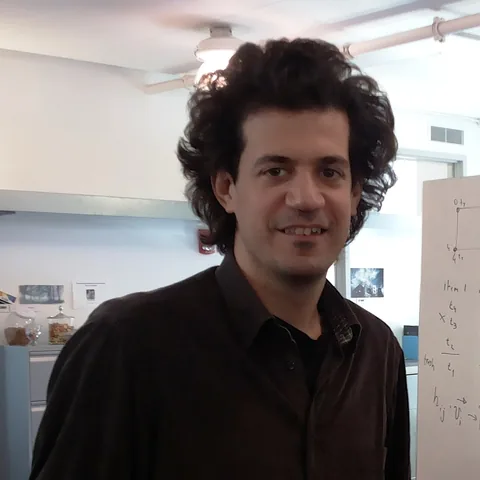 Constantinos DaskalakisMassachusetts Institute of Technology, 2017–2018
 John J. LeonardMassachusetts Institute of Technology, 2017–2018
 Hendrik Van BrusselKU Leuven, 2017–2018
Sources and credits
Photo: We have no published photo of Jonas Kubilius yet. Send us a free-licensed photo.
- Jonas Kubilius – Architektūros fondas
- Jonas Kubilius
- A conceptual framework of computations in mid-level vision
- Deep Neural Networks as a Computational Model for Human Shape Sensitivity | PLOS Computational Biology
- Dirbtinio intelekto tyrėjas J.Kubilius: „Mašinos, kaip ir vaikai, mokosi iš mūsų“ | 15min.lt
- Team | Jones!Lab
- Toward Goal-Driven Neural Network Models for the Rodent Whisker-Trigeminal System
- Task-Driven Convolutional Recurrent Models of the Visual System
- The Swamp Pavilion
- Swamp Intelligence, Taipei Biennial, 2020 – US:Urbonas Studio
- Evidence that recurrent circuits are critical to the ventral stream’s execution of core object recognition behavior | Nature Neuroscience
- Tidying up deep neural networks - MIT McGovern Institute
- Brain-Like Object Recognition with High-Performing Shallow Recurrent ANNs
- GitHub - dicarlolab/CORnet: [NeurIPS'19 Oral] CORnet: Modeling the Neural Mechanisms of Core Object Recognition
- Open Positions | Jones!Lab