Kuan Fang
Also known as 房宽
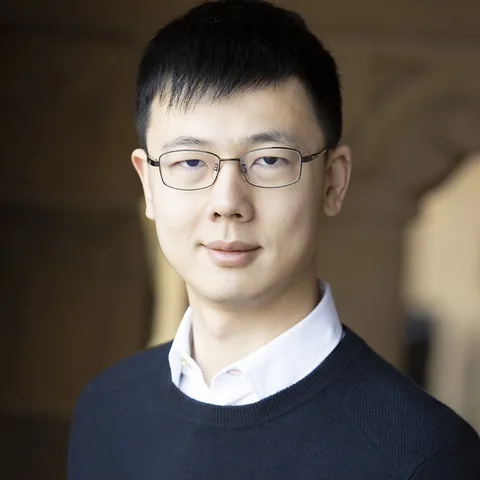
Kuan Fang is an assistant professor of computer science at Cornell University whose research works at the intersection of robotics, machine learning and computer vision. After earning a bachelor's degree at Tsinghua University, he completed an M.S. and a Ph.D. at Stanford University by September 2021 under Fei-Fei Li and Silvio Savarese, coauthoring the TOG-Net tool-grasping network in 2018, the CAVIN planner in 2019 and the SLIDE skill-discovery method in 2021. He began a postdoctoral position at UC Berkeley in October 2021, working with Sergey Levine, where he coauthored a lossy-affordance offline reinforcement learning framework in 2022 as well as the BridgeData V2 and Open X-Embodiment datasets in 2023. Following research at the Boston Dynamics AI Institute, he joined Cornell in Fall 2024, coauthored the MOKA manipulation framework in 2024, and received a 2026 IEEE Robotics and Automation Letters Best Paper Award for a June 2025 study on contact-rich manipulation policies. At Cornell, his lab develops scalable algorithms and systems for robot perception and control, and he teaches Deep Learning for Robotics in Fall 2026.
- Now at
- Cornell University
Timeline
-
2018
Tool grasping with TOG-Net
In 2018, he publishes the Task-Oriented Grasping Network (TOG-Net) with Yuke Zhu, Animesh Garg, Andrey Kurenkov, Viraj Mehta, Li Fei-Fei and Silvio Savarese to jointly optimize task-oriented grasping of a tool and the manipulation policy for that tool. The model reaches a 71.1% task success rate for sweeping and an 80.0% task success rate for hammering.
-
2019
The CAVIN planner
In 2019, he coauthors the Cascaded Variational Inference (CAVIN) Planner with Yuke Zhu, Animesh Garg, Silvio Savarese and Li Fei-Fei for CoRL 2019. The model-based method hierarchically generates plans by sampling from latent spaces and outperforms state-of-the-art model-based methods on three multi-step manipulation tasks.
-
By October 2021
Stanford doctorate and skill discovery
Fang earns a bachelor's degree from Tsinghua University and an M.S. and Ph.D. from Stanford University, advised by Fei-Fei Li and Silvio Savarese, completing his doctorate by September 2021 and starting as a postdoctoral researcher at UC Berkeley in October 2021. In 2021, he also coauthors Skill Learning In Diversified Environments (SLIDE), a method that discovers generalizable robot skills via automated generation of diverse tasks.
-
2022
Offline RL with lossy affordances
In 2022, he coauthors Generalization with Lossy Affordances, a framework that acquires goal-conditioned policies for unseen temporally extended visuomotor tasks via offline reinforcement learning on broad data.
-
2023
Open datasets for generalist robots
In August 2023, he coauthors BridgeData V2, a dataset of 60,096 trajectories collected across 24 environments on a publicly available low-cost robot. In October 2023, he is an author of Open X-Embodiment, which assembles data from 22 robots across 21 institutions covering 527 skills and trains the high-capacity RT-X model with positive transfer across robot platforms.
-
2024
Joining Cornell and the MOKA framework
By 2024, he works as a postdoctoral researcher at UC Berkeley with Sergey Levine and as a researcher at the Boston Dynamics AI Institute; Cornell announces him as an incoming assistant professor of computer science for Fall 2024 and profiles him in October 2024. In 2024, he also coauthors Marking Open-world Keypoint Affordances (MOKA), which uses vision-language models to solve robotic manipulation tasks specified by free-form language instructions.
-
2025–2026
An RA-L Best Paper Award
In June 2025, with Huaijiang Zhu, Tong Zhao, Xinpei Ni, Jiuguang Wang, Ludovic Righetti and Tao Pang, he publishes an IEEE Robotics and Automation Letters paper investigating how model-based planning and optimization generate training data for contact-rich dexterous manipulation policies. The IEEE Robotics and Automation Society names the coauthors recipients of a 2026 IEEE Robotics and Automation Letters Best Paper Award for the paper.
-
As of October 2026
Assistant professor at Cornell
He is an assistant professor of computer science at Cornell University, where he conducts research at the intersection of robotics, machine learning and computer vision. His lab develops scalable algorithms and systems for robot perception and control, and in Fall 2026 he teaches Cornell's Deep Learning for Robotics course (CS 6758).
Career
- NowCornell UniversityAssistant professor of computer science
- University of California, BerkeleyPostdoctoral researcher
- Robotics and AI InstituteResearcher
Education
- Tsinghua UniversityBachelor's degree
- Stanford UniversityPh.D.
Colleagues
Sources and credits
Photo: We have no published photo of Kuan Fang yet. Send us a free-licensed photo.
- Learning Task-Oriented Grasping for Tool Manipulation from Simulated Self-Supervision
- Dynamics Learning with Cascaded Variational Inference for Multi-Step Manipulation
- Kuan Fang | Department of Computer Science | Cornell Bowers
- Kuan Fang
- Computer Vision News - September 2021
- [2106.13935] Discovering Generalizable Skills via Automated Generation of Diverse Tasks
- [2210.06601] Generalization with Lossy Affordances: Leveraging Broad Offline Data for Learning Visuomotor Tasks
- BridgeData V2: A Dataset for Robot Learning at Scale
- Open X-Embodiment: Robotic Learning Datasets and RT-X Models
- 11 new faculty to join Bowers CIS | Cornell Bowers
- Meet the new faculty: Kuan Fang | Cornell Bowers
- MOKA: Open-World Robotic Manipulation through Mark-Based Visual Prompting
- IEEE Robotics and Automation Letters Best Paper Award - IEEE Robotics and Automation Society Website
- [2412.09743] Should We Learn Contact-Rich Manipulation Policies from Sampling-Based Planners?
- CS 6758: Deep Learning for Robotics — Cornell University