Farzan Farnia
Farzan Farnia is an AI researcher whose work spans minimax supervised learning, GAN theory, and evaluation of generative models. He received a Stanford Graduate Fellowship from 2013 to 2016 and won a 2014 prize for Stanford Electrical Engineering Ph.D. qualifying-exam performance; he holds degrees from Sharif University of Technology and Stanford. In 2016, he and David Tse introduced the minimax SVM, and Farnia's later GAN research examined training theory and game equilibria. In 2026, he coauthored a method for measuring diversity in prompt-based generative models, and he is an assistant professor at CUHK as of October 2026.
Timeline
-
2013–2016
A Stanford fellowship and prize
He receives a Stanford Graduate Fellowship from 2013 to 2016. In 2014, he wins the Numerical Technology Founders Prize as the second top performer of Stanford Electrical Engineering Ph.D. qualifying exams.
-
2016
The minimax SVM
In 2016, he and David Tse introduce a minimax framework for supervised learning and derive the minimax SVM, which minimizes worst-case expected 0–1 loss.
-
2018
A convex duality framework for GANs
At NeurIPS 2018, he and David Tse develop a convex duality framework to analyze how constrained discriminators affect GAN training.
-
2019
Electrical engineering at Sharif and Stanford
He holds a B.Sc. in electrical engineering and mathematics from Sharif University of Technology and M.Sc. and Ph.D. degrees in electrical engineering from Stanford. At his May 2019 Ph.D. defense, he presents an information-theoretic framework for supervised learning.
-
2019–2021
Postdoctoral work at MIT
From 2019 to 2021, he works as a postdoctoral research associate at MIT's Laboratory for Information and Decision Systems.
-
2020
Proximal training for GANs
In 2020, he and Asuman Ozdaglar show that GAN zero-sum games may lack Nash equilibria and propose proximal equilibrium and proximal training.
-
May 2026
Prompt-aware diversity scoring
In May 2026, he and Mohammad Jalali, Azim Ospanov, and Amin Gohari publish Conditional Vendi Score, a method for measuring prompt-induced and model-induced diversity in generative outputs.
-
As of October 2026
Assistant professor at CUHK
As of October 2026, he is an assistant professor in CUHK's Department of Computer Science and Engineering; his research covers machine learning, deep learning theory, optimization, and information theory.
Career
- NowChinese University of Hong KongAssistant Professor
- 2019–2021Massachusetts Institute of TechnologyPostdoctoral Research Associate
Education
- 2019Stanford UniversityM.Sc.
- Sharif University of TechnologyB.Sc.
Colleagues


Sources and credits
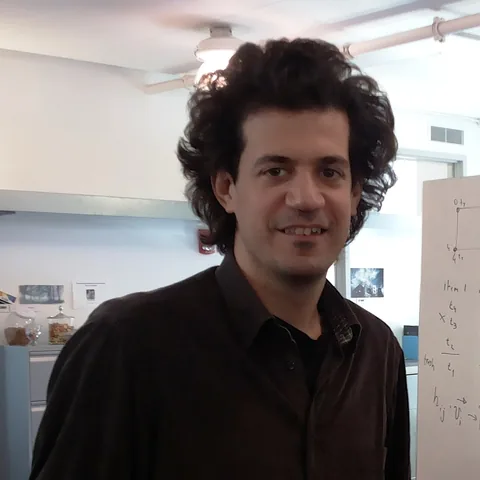
Photo: We have no published photo of Farzan Farnia yet. Send us a free-licensed photo.
- Farzan Farnia – CUHK CSE
- A Minimax Approach to Supervised Learning
- A Convex Duality Framework for GANs
- Do GANs always have Nash equilibria?
- PhD Oral Defense: Farzan Farnia | Tse Lab at Stanford University
- Conditional Vendi Score: Prompt-Aware Diversity Evaluation for Generative AI Models and LLMs
- Farzan FARNIA - The Chinese University of Hong Kong