Aming Li
Also known as 李阿明
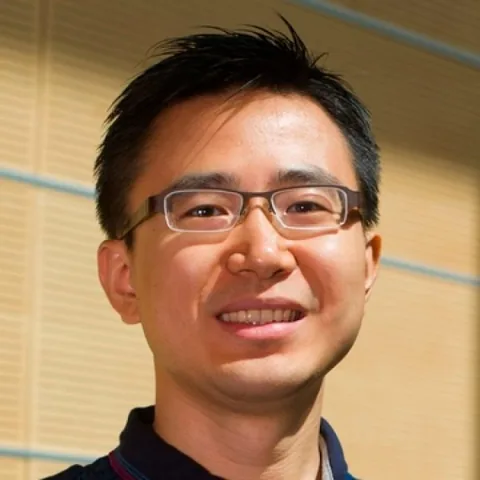
Aming Li is a Peking University researcher who studies swarm intelligence and develops reinforcement learning for network control. He earned a mathematics degree at Zhejiang University of Technology in 2011 and a PhD at Peking's Center for Systems and Control in 2017. He visited research groups at MIT and Northeastern during his doctorate, then held postdoctoral roles at ETH Zurich and Oxford. His papers study cooperation on temporal networks and develop decentralized reinforcement learning for large-scale network control. He is an Associate Professor at Peking University, holds the title 特聘研究员 at its School of Advanced Manufacturing and Robotics, and directs Peking's Robotics Research Center.
- Now at
- Peking University
- Works
- 118
- Citations
- 2,164
- h-index
- 25
- Badges
Publication numbers from OpenAlex, as of 27 October 2026.
Timeline
-
2007–2017
Mathematics and a Peking PhD
He studies mathematics at Zhejiang University of Technology from September 2007 to June 2011 and earns a BSc in 2011. He studies at Peking University's Center for Systems and Control from September 2011 to July 2017 and earns a PhD in 2017. During his doctorate, he is a visiting student at MIT's Physics of Living Systems, in Jeff Gore's lab, from October 2015 to March 2017, and a visiting research scholar at Northeastern University from 2014 to 2017.
-
2017
A Science paper on temporal networks
In 2017, he coauthors “The fundamental advantages of temporal networks” in Science. Its analytical framework finds that temporal networks reach controllability faster and require orders of magnitude less control energy than static networks.
-
2017–2018
ETH postdoctoral research
From November 2017 to June 2018, he is a postdoctoral research associate in ETH Zurich's Department of Management, Technology and Economics.
-
2018
An HFSP fellowship award
In 2018, he receives the International Human Frontier Science Program Organization Cross-Disciplinary Fellowship Award.
-
2018–2020
Oxford's Foster Lab postdoc
From July 2018 to October 2020, he is a postdoctoral fellow in Oxford's Foster Lab.
-
2020–2025
Joining Peking University
From November 2020 to July 2026, he is an assistant professor at Peking University. From November 2020 to May 2025, he also holds the title 特聘研究员 and is a doctoral adviser in its College of Engineering. In June 2025, he moves within Peking to the School of Advanced Manufacturing and Robotics as a 特聘研究员 and doctoral adviser. His 2020 paper “Evolution of cooperation on temporal networks” finds that temporal networks can enhance cooperation compared with static networks.
-
2024
Strategy updates and network control
In 2024, he coauthors “Dynamics of collective cooperation under personalised strategy updates,” finding that cooperation can improve when people with more network connections update strategies less often. He also coauthors an efficient and scalable reinforcement learning paper that develops a model-based decentralized policy optimization framework for large-scale network control in multi-agent systems.
-
2025–2026
PNAS and Nature cooperation papers
In 2025, he coauthors the PNAS paper “Promoting collective cooperation through temporal interactions,” which gives a condition for cooperation on arbitrary temporal networks and connects evolutionary game dynamics with static and temporal interactions. In 2026, he coauthors “Temporality modulates the effect of network heterogeneity on cooperation fixation,” finding that structural heterogeneity can promote cooperation and that the advantages depend on fixation time.
-
2026
Robotics department leadership
In June 2026, he is deputy head of Peking's Robotics Science and Engineering Department, assistant to the dean, and a member of the undergraduate robotics engineering committee.
-
As of October 2026
Associate Professor and center director
He is an Associate Professor at Peking University from August 2026. At the School of Advanced Manufacturing and Robotics, he holds the title 特聘研究员 and supervises doctoral students. In September 2026, he meets Fuyang Normal University leaders as director of Peking University's Robotics Research Center. His group focuses on swarm intelligence, evolutionary games and networked-system control. The current AMR faculty page also lists him as deputy head of the Robotics Science and Engineering Department and Co-PI of Peking University’s Advanced Innovation Center for Engineering Science and Emerging Technologies. A report of the June 2026 meeting names him as assistant to the dean of the College of Engineering.
Career
- Since 2026Peking UniversityAssociate Professor
- Since 2025Peking University特聘研究员 and doctoral adviser
- NowPeking UniversityDeputy head
- NowPeking UniversityDirector, Robotics Research Center
- NowPeking UniversityCo-PI, Advanced Innovation Center for Engineering Science and Emerging Technologies
- 2021–2026Beijing Academy of Artificial Intelligence
- 2020–2026Peking UniversityAssistant professor
- 2020–2025Peking University特聘研究员 and doctoral adviser
- 2018–2020University of OxfordPostdoctoral fellow, Foster Lab
- 2017–2018ETH ZurichPostdoctoral research associate
- 2015–2017Massachusetts Institute of TechnologyVisiting student, Physics of Living Systems, Jeff Gore's lab
- 2014–2017Northeastern UniversityVisiting research scholar
- Peking UniversityAssistant to the dean
- Peking UniversityMember of the undergraduate robotics engineering committee
Education
- 2017Peking UniversityPhD, Center for Systems and Control
- 2011Zhejiang University of TechnologyBSc
Colleagues


Sources and credits
Photo: We have no published photo of Aming Li yet. Send us a free-licensed photo.
- Aming Li-北京大学人工智能研究院
- Aming Li's Homepage
- 李阿明_北京大学先进制造与机器人学院
- The fundamental advantages of temporal networks
- Evolution of cooperation on temporal networks | Nature Communications
- Dynamics of collective cooperation under personalised strategy updates | Nature Communications
- Efficient and scalable reinforcement learning for large-scale network control | Nature Machine Intelligence
- Promoting collective cooperation through temporal interactions - PMC
- Temporality modulates the effect of network heterogeneity on cooperation fixation | Nature Communications
- 先进制造与机器人学院举行机器人工程专业本科生培养对接座谈会
- 方廷勇会见北京大学机器人研究中心主任李阿明