Jeannette Bohg
Jeannette Bohg is an associate professor of computer science at Stanford who develops perception and learning methods for robots that grasp and manipulate objects. She studied computer science in Dresden and art and technology at Chalmers, then completed a doctorate at KTH under Danica Kragic. After research with Stefan Schaal at the Max Planck Institute for Intelligent Systems from 2012 to 2017, she moved to Stanford in 2017, where she directs the Interactive Perception and Robot Learning Lab. Her coauthored work includes Concept2Robot in 2020, TidyBot in 2023 and DexForce in 2025, which use human demonstrations, language and contact forces to teach robots physical skills. She received an IEEE early career award in 2019 and a Sloan Research Fellowship in 2023.
- Now at
- Stanford University
- Works
- 225
- Citations
- 11,319
- h-index
- 46
Publication numbers from OpenAlex, as of 27 October 2026.
Timeline
-
1981–2000
From Spreewald to computer science
Bohg is born in 1981 and grows up on a farm in Spreewald, in eastern Germany. In 2000, she finishes high school and applies to study computer science.
-
By 2012
Degrees in Dresden and Sweden
She earns a diploma in computer science at the Technical University of Dresden and a master’s in art and technology at Chalmers University of Technology in Gothenburg. Before her move to Max Planck in January 2012, she completes a doctorate in KTH’s Division of Robotics, Perception and Learning in Stockholm, advised by Danica Kragic. Her thesis develops methods for understanding scenes through multiple senses to help robots grasp objects.
-
2012–2017
Research with Stefan Schaal
From 2012 to 2017, she works as a postdoctoral researcher and then a group leader in Stefan Schaal’s Autonomous Motion Department at the Max Planck Institute for Intelligent Systems in Tübingen. Her research combines robotic manipulation, machine learning and 3D computer vision.
-
2017
A lab at Stanford
In 2017, she moves to Stanford and sets up her laboratory.
-
2019
Vision, touch and IEEE awards
In 2019, she coauthors Making Sense of Vision and Touch: Self-Supervised Learning of Multimodal Representations for Contact-Rich Tasks, which wins the ICRA Best Conference Paper Award. She also receives the 2019 IEEE Robotics and Automation Society Early Academic Career Award for contributions to robot perception and learning for manipulation.
-
2020
Concept2Robot learns manipulation skills
In 2020, she coauthors Concept2Robot with Lin Shao, Toki Migimatsu, Qiang Zhang and Kaiyuan Yang. The system uses human demonstration videos, reinforcement learning and imitation learning to connect language instructions to robot movements; its experiments train a policy across 78 manipulation tasks in simulation.
-
2023
A Sloan Research Fellowship
She receives an Alfred P. Sloan Research Fellowship in 2023.
-
October 2023
TidyBot learns household preferences
In October 2023, she coauthors TidyBot: Personalized Robot Assistance with Large Language Models. The system uses large language models to learn where a person likes to store objects from a few examples, and its mobile robot puts away 85.0% of objects in real-world test scenarios.
-
January 2025
DexForce learns from contact forces
In January 2025, she coauthors DexForce with Claire Chen, Zhongchun Yu, Hojung Choi and Mark Cutkosky. The method measures contact forces while a person physically guides a robot, then uses those measurements to train manipulation policies; across six tasks, the policies achieve an average success rate of 76%.
-
As of October 2026
Associate professor at Stanford
As of October 2026, she is an associate professor of computer science at Stanford and directs the Interactive Perception and Robot Learning Lab. Her research develops perception and learning methods for autonomous robotic manipulation and grasping.
Career
- NowStanford UniversityAssociate Professor of Computer Science
- NowStanford UniversityDirector, Interactive Perception and Robot Learning Lab
- Until 2017Max Planck Institute for Intelligent SystemsGroup Leader
- From 2017Stanford University
- From 2012Max Planck Institute for Intelligent SystemsPostdoctoral Researcher
- 2012–2017Max Planck Society
Education
- Technische Universität DresdenDiploma in computer science
- Chalmers University of TechnologyMaster's in art and technology
- KTH Royal Institute of TechnologyDoctorate
Colleagues
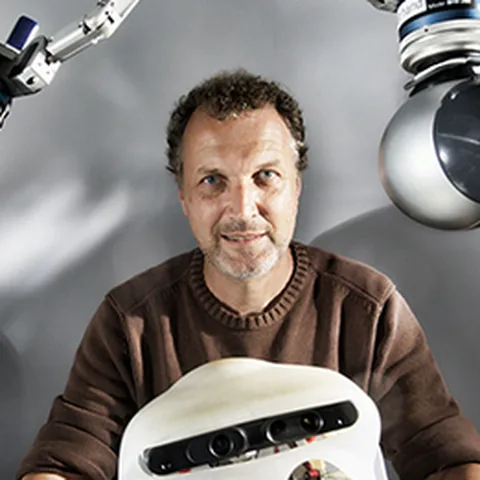 Stefan SchaalMax Planck Institute for Intelligent Systems, 2012–2020
- Lin ShaoNamed in this biography
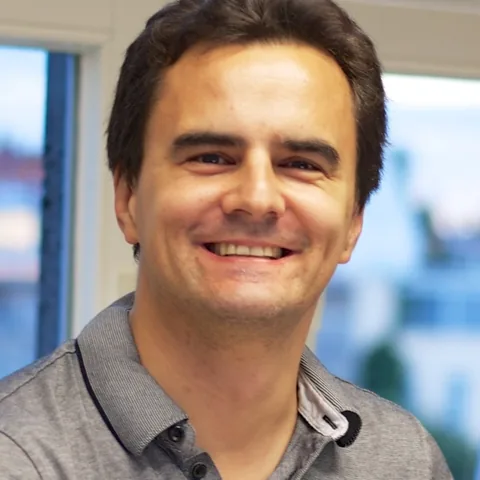 Jan PetersMax Planck Institute for Intelligent Systems, 2012–2020
- Peer FischerMax Planck Institute for Intelligent Systems, 2012–2020
- Lei XingStanford University, 2017–2026
- Daniel L. RubinStanford University, 2017–2026
Sources and credits
Photo: We have no published photo of Jeannette Bohg yet. Send us a free-licensed photo.
- Interview with Jeanette Bogh - Robotics History Project
- Jeannette Bohg
- Jeannette Bohg's Profile | Stanford Profiles
- Jeannette Bohg - Tübingen AI Center
- New center unites Stanford’s robotics expertise under one roof
- IEEE ICRA Best Conference Paper Award
- Early Academic Career Award in Robotics and Automation
- Concept2Robot: Learning Manipulation Concepts from Instructions and Human Demonstrations
- TidyBot: Personalized Robot Assistance with Large Language Models
- DexForce: Extracting Force-informed Actions from Kinesthetic Demonstrations for Dexterous Manipulation
- Jeannette Bohg | Computer Science
- IEEE ICRA 2026 | Keynote Sessions