Wittawat Jitkrittum
Also known as วิทวัส จิตกฤตธรรม, Wit
Wittawat Jitkrittum is a machine learning researcher whose work on model routing and cascades makes large language models cheaper to run. After computer science studies at SIIT in Thailand and the Tokyo Institute of Technology, he earned a PhD in machine learning at the Gatsby Unit of University College London. His 2017 paper A Linear-Time Kernel Goodness-of-Fit Test won a NeurIPS Best Paper Award. He worked as a postdoctoral researcher at the Max Planck Institute for Intelligent Systems from 2018, then as a research scientist at Google Research from 2020, and his paper Faster Cascades via Speculative Decoding received an ICLR 2025 Outstanding Paper Honorable Mention. Since February 2026, he is an independent researcher working on model orchestration.
Timeline
-
2010–2012
Computer science in Thailand and Tokyo
He earns a BSc in computer science at SIIT in Thailand and an MEng in computer science at the Tokyo Institute of Technology. A full Okazaki Kaheita Scholarship supports his master's degree from 2010 to 2012.
-
2013–2017
PhD at the Gatsby Unit
A full scholarship from the Gatsby Unit funds his PhD in machine learning at University College London from 2013 to 2017. From 2015, his research develops sample-efficient, kernel-based statistical tests for comparing distributions and models.
-
2017
A NeurIPS best paper award
In 2017, A Linear-Time Kernel Goodness-of-Fit Test, written with Wenkai Xu, Zoltan Szabo, Kenji Fukumizu and Arthur Gretton, wins a NeurIPS Best Paper Award. The test learns the features that best indicate differences between samples and a reference model, at a computational cost linear in the number of samples.
-
2018–2020
Postdoc at Max Planck
From 2018 to 2020, he is a postdoctoral researcher at the Max Planck Institute for Intelligent Systems.
-
2020–2024
Research scientist at Google Research
He joins Google Research as a research scientist in 2020, and from 2022 his research covers model routing for efficient inference and teacher-based training of large language models. In 2023, he is first author of a NeurIPS paper with Neha Gupta, Aditya Krishna Menon, Harikrishna Narasimhan, Ankit Singh Rawat and Sanjiv Kumar that asks when confidence-based cascade deferral suffices.
-
2023–2024
Two Google Tech Impact Awards
He receives a Google Research Tech Impact Award in 2023 for his work on cascade models. In 2024, a Google Tech Impact Award for model routing names that project one of the ten most impactful of the year.
-
2025
Speculative cascades and UniRoute
Faster Cascades via Speculative Decoding, written with Harikrishna Narasimhan, Ankit Singh Rawat, Seungyeon Kim, Neha Gupta, Aditya Krishna Menon and Sanjiv Kumar, earns an Outstanding Paper Honorable Mention at ICLR 2025. Its speculative cascades implement a cascade's deferral rule through speculative execution and, on T5 and Gemma models, match the quality of a regular cascade at reduced inference cost. In February 2025, he also posts Universal Model Routing for Efficient LLM Inference, whose UniRoute method routes prompts among more than 30 unseen LLMs.
-
Since February 2026
Independent researcher on orchestration
He serves as a senior research scientist at Google Research from 2024 and at Google DeepMind from 2025, then becomes an independent researcher in February 2026. His current research thread is model orchestration, which asks how many generalist and specialist models of various sizes can complete a task together.
Career
- 2025–2026Google DeepMindSenior Research Scientist
- 2020–2025Google ResearchResearch scientist, Senior Research Scientist
- 2018–2020Max Planck Institute for Intelligent SystemsPostdoctoral researcher
Education
- 2017University College LondonPhD in machine learning
- 2012Institute of Science TokyoMEng in computer science
- Sirindhorn International Institute of TechnologyBSc in computer science
Videos
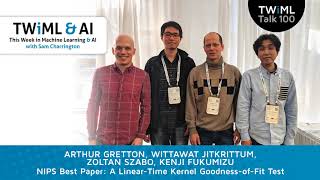
Video data from YouTube API Services. By watching you agree to the YouTube Terms of Service. How we use YouTube data.
Colleagues

Sources and credits
Photo: We have no published photo of Wittawat Jitkrittum yet. Send us a free-licensed photo.
- Wittawat Jitkrittum
- Awards (NeurIPS 2017)
- [1705.07673] A Linear-Time Kernel Goodness-of-Fit Test
- NeurIPS Best Paper: A Linear-Time Kernel Goodness-of-Fit Test | TWIML
- [2307.02764] When Does Confidence-Based Cascade Deferral Suffice?
- Announcing the Outstanding Paper Awards at ICLR 2025 – ICLR Blog
- Faster Cascades via Speculative Decoding
- [2502.08773] Universal Model Routing for Efficient LLM Inference