Iman Aganj
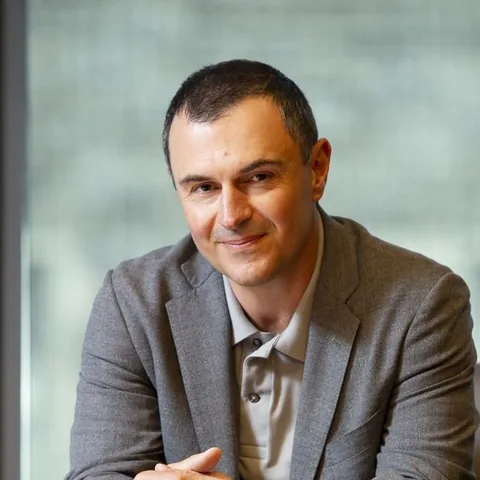
Iman Aganj is a medical-imaging researcher whose work spans MRI analysis, image segmentation, and brain connectivity. He earned a computer science degree at École Polytechnique in 2005 and a PhD in electrical engineering at Minnesota in 2010, then joined the Martinos Center in 2011. In 2014, he received funding for a project on connectomic biomarkers of Alzheimer’s disease. His later work includes an expected-label-value segmentation method, Alzheimer’s connectome analysis, and graph neural networks for cortical segmentation and clinical prediction. As of October 2026, he is an assistant professor of radiology at Harvard Medical School and an investigator at the Martinos Center.
- Now at
- Harvard University and Mass General Brigham
- Works
- 131
- Citations
- 1,656
- h-index
- 19
Publication numbers from OpenAlex, as of 27 October 2026.
Timeline
-
2005–2011
Computer science and MRI
He earns a BSc in computer science from École Polytechnique in 2005 and an MSc and PhD in electrical engineering from the University of Minnesota, completing the doctorate in 2010. His doctoral work develops MRI methods for cortical-thickness measurement, diffusion-weighted fiber tracking, and high-resolution reconstruction. At the Martinos Center, he joins in 2011 and works on image registration and segmentation, diffusion MR analysis, and brain connectivity.
-
2014
An Alzheimer’s connectomics grant
A recently promoted faculty member of the Laboratory for Computational Neuroimaging, he receives his first funding award in 2014 for a proposal on connectomic biomarkers of Alzheimer’s disease observed in multisynaptic pathways. The project is selected for funding through the Harvard NeuroDiscovery Center, Massachusetts ADRC, and MGH Neurological Clinical Research Institute’s 2014 Neurodegenerative Diseases Pilot Study Grants program.
-
2021
Expected label value segmentation
In 2021, he and Bruce Fischl publish an expected-label-value method for soft medical-image segmentation. It estimates the expected label by considering possible atlas-to-image transformations, avoids deformable registration, and is evaluated on brain, liver, and pancreas MRI and CT datasets.
-
2023
Mapping Alzheimer’s connectomes
In 2023, he and coauthors explore structural connectivity against clinical and demographic variables in four diffusion-MRI databases, including three related to Alzheimer’s disease. They identify 85 significant relationships using direct connections and 101 when they add multisynaptic pathways.
-
2026
Graph models for brain MRI
In February 2026, he coauthors a graph neural network study of cortical-surface segmentation that combines structural MRI features with diffusion-MRI connectivity; the multimodal model reports a Dice score of 0.927. In May 2026, he coauthors a graph-based deep model for predicting demographic and clinical variables from structural brain connectivity.
-
As of October 2026
Harvard radiology faculty
As of October 2026, he is an assistant professor of radiology at Harvard Medical School and an investigator at the Martinos Center. His research covers medical-image registration and segmentation, diffusion-MR reconstruction and analysis, and brain connectivity; his 2026 work includes cardiac-MRI segmentation and graph-based connectome prediction.
Career
- NowMass General BrighamInvestigator
- NowHarvard UniversityAssistant Professor of Radiology
Education
- 2010University of MinnesotaPhD in Electrical Engineering
- 2005École PolytechniqueBSc in Computer Science
- University of MinnesotaMSc in Electrical Engineering
Colleagues

Sources and credits
Photo: We have no published photo of Iman Aganj yet. Send us a free-licensed photo.
- Iman Aganj, Ph.D. | Mass General Research Institute
- Iman Aganj, PhD | BrightFocus Foundation
- The Martinos Center’s Got Talent! – Martinos Center
- Martinos investigators receive funding for study of neurodegenerative diseases | MGH/HST Martinos Center for Biomedical Imaging
- Multi-Atlas Image Soft Segmentation via Computation of the Expected Label Value – PMC
- Exploratory correlation of the human structural connectome with non-MRI variables in Alzheimer’s disease – PMC
- Multimodal connectivity-based cortical segmentation with graph neural networks | Frontiers
- Structural connectome analysis using a graph-based deep model for prediction of non-imaging variables | Frontiers
- Aganj, Iman – Martinos Center