Boris Hanin
Boris Hanin is a mathematician who applies mathematical tools to questions in deep learning theory. He studied mathematics at Stanford and Northwestern, held an NSF postdoctoral fellowship in MIT's mathematics department, and moved from Texas A&M to Princeton. His research examines narrow ReLU networks, gradient stability in deep networks, compute-efficient transformers, and diffusion models. He contributed to The Principles of Deep Learning Theory and received a 2024 Sloan Research Fellowship in mathematics. As of October 2026, he is an associate professor at Princeton, where he studies deep learning, probability, and spectral asymptotics.
- Now at
- Princeton University
Timeline
-
2009–2014
Mathematics at Stanford and Northwestern
He earns a B.S. in mathematics at Stanford in 2009 and completes a Ph.D. in mathematics at Northwestern in 2014.
-
2014–2017
MIT postdoc and Texas A&M
After earning his mathematics Ph.D. at Northwestern in 2014, he is an NSF Postdoctoral Fellow in MIT's mathematics department. He joins the math faculty at Texas A&M as an assistant professor in 2017.
-
2017
Narrow ReLU approximation
In 2017, he proves that ReLU nets with width d+1 can approximate any continuous convex function of d variables and gives depth estimates for narrow-network approximation.
-
2018
Random matrices and deep gradients
In 2018, Hanin and Mihai Nica post Products of Many Large Random Matrices and Gradients in Deep Neural Networks, which quantifies exploding and vanishing gradients in randomly initialized deep ReLU networks.
-
2020
Joining Princeton ORFE
He joins Princeton's Department of Operations Research and Financial Engineering in 2020 as an assistant professor, following an MIT mathematics postdoc and an assistant professorship at Texas A&M.
-
2021
The Principles of Deep Learning Theory
He contributes research to The Principles of Deep Learning Theory with Daniel A. Roberts and Sho Yaida in 2021. The book develops an effective-theory approach to understanding practical deep neural networks.
-
2024
A Sloan Research Fellowship
The Alfred P. Sloan Foundation names him a 2024 Sloan Research Fellow in mathematics.
-
2024
Applying physics to neural networks
In 2024, he applies mathematical physics to identify principles that govern large neural networks and aims to help developers improve AI system designs before building them.
-
2025–2026
Transformer training and diffusion models
In 2025, he coauthors the NeurIPS paper Don't be lazy: CompleteP enables compute-efficient deep transformers, which studies how hyperparameter choices transfer as model size changes. In 2026, he and Peter Halmos connect score-based diffusion sampling to adiabatic transport of Schrödinger ground states.
-
As of October 2026
Associate Professor at Princeton
In Spring 2025, Princeton Engineering commends him for teaching ORF 350. As of October 2026, he is an associate professor of operations research and financial engineering at Princeton, working on deep learning, probability, and spectral asymptotics.
Career
- NowPrinceton UniversityAssociate professor
- From 2017Texas A&M UniversityAssistant professor
- 2014–2017Massachusetts Institute of TechnologyNSF Postdoctoral Fellow
Education
- 2014Northwestern UniversityPh.D. in mathematics
- 2009Stanford UniversityB.S. in mathematics
Colleagues
 Robin R MurphyTexas A&M University, 2017–2020
 Zhangyang “Atlas” WangTexas A&M University, 2017–2020
 Nancy M. AmatoTexas A&M University, 2017–2020
- Kamal Youcef-ToumiMassachusetts Institute of Technology, 2014–2017
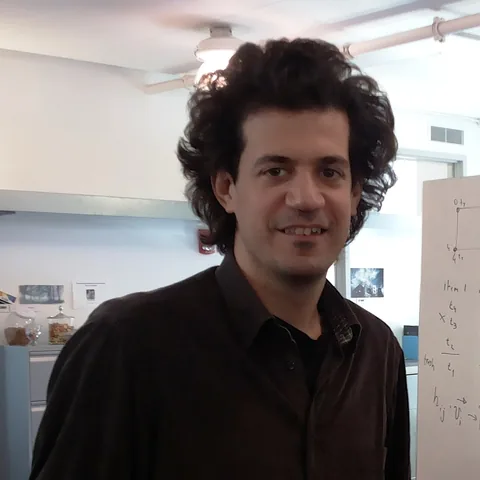 Constantinos DaskalakisMassachusetts Institute of Technology, 2014–2017
 John J. LeonardMassachusetts Institute of Technology, 2014–2017
Sources and credits
Photo: We have no published photo of Boris Hanin yet. Send us a free-licensed photo.
- Boris Hanin
- Three faculty members named Sloan Research Fellows
- [1708.02691] Universal Function Approximation by Deep Neural Nets with Bounded Width and ReLU Activations
- [1812.05994] Products of Many Large Random Matrices and Gradients in Deep Neural Networks
- Boris Hanin | boris-hanin
- [2106.10165] The Principles of Deep Learning Theory
- [2505.01618] Don't be lazy: CompleteP enables compute-efficient deep transformers
- [2606.05217] The Score Hamiltonian: Mapping Diffusion Models to Adiabatic Transport
- Faculty commended for outstanding teaching
- Boris Hanin - Princeton Engineering