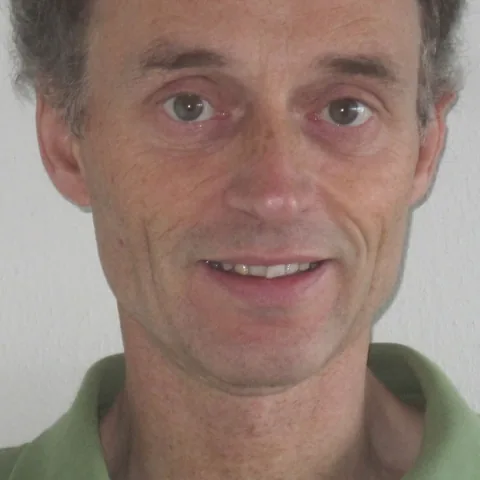
Vitaly Ablavsky
Vitaly Ablavsky is a computer vision researcher at the University of Washington whose work includes tracking objects from natural language descriptions. He studied mathematics at Brandeis and computer science at the University of Massachusetts Amherst, then earned a Boston University PhD in 2011. His research included tracking a ball through team play in 2014, the Siamese Natural Language Tracker in 2021, and the ZeroWaste recycling dataset in 2022. In 2026, he coauthored SAGA-ReID research on recognizing the same person across images when parts of the person are hidden. He is a principal research scientist at UW's Applied Physics Laboratory and an affiliate assistant professor in electrical and computer engineering.
- Now at
- University of Washington
- Works
- 56
- Citations
- 1,067
- h-index
- 17
Publication numbers from OpenAlex, as of 27 October 2026.
Timeline
-
1992–1996
Mathematics and computer science
He earns a BA in mathematics at Brandeis University in 1992 and an MS in computer science at the University of Massachusetts Amherst in 1996.
-
2011
A doctorate at Boston University
Before his doctorate, he contributes to machine vision research and development at Charles River Analytics, Cognex and Amerinex Applied Imaging with ADCIS. In 2011, he earns a computer science PhD in Boston University's Image and Video Computing group, advised by Stan Sclaroff, studying graphical models for tracking. He then holds a postdoctoral appointment in EPFL's CVLab with Pascal Fua and Vincent Lepetit, working on activity recognition and transfer learning.
-
2014
Tracking balls through team play
In 2014, he coauthors “Take your Eyes off the Ball: Improving Ball-Tracking by Focusing on Team Play” with Xinchao Wang, Horesh Ben Shitrit and Pascal Fua. The method tracks the ball by deciding which player has possession, and is tested on basketball and soccer videos.
-
2015
Research at STR
In 2015, he works at Systems & Technology Research (STR) and serves on the technical program committee of the Fusion 2015 conference. As a senior member of technical staff in STR's Video and Image Understanding group, he contributes to research and development and leads technical areas on DARPA and IARPA programs.
-
August 2019
Recycling research at Boston University
In August 2019, he is a senior research scientist in computer science at Boston University and an investigator on an NSF-funded study of human–robot collaboration in recycling. The project examines whether robots can improve waste sorting, recycling quality and working conditions.
-
2021
Siamese Natural Language Tracker
In 2021, he coauthors the Siamese Natural Language Tracker with Qi Feng, Qinxun Bai and Stan Sclaroff at CVPR. The system combines visual information and natural language descriptions to track objects, and runs at 50 frames per second on a single GPU in the reported tests.
-
2022
The ZeroWaste dataset
In 2022, he coauthors the ZeroWaste dataset paper at CVPR. ZeroWaste provides images from an industrial recycling setting for detecting and segmenting waste, including deformable and translucent objects in cluttered scenes.
-
2024
Learning to track with SSP-GNN
In 2024, he coauthors “SSP-GNN: Learning to Track via Bilevel Optimization” with Griffin Golias and Masa Nakura-Fan. The method combines a shortest-path tracking algorithm with a graph neural network whose parameters are learned from example tracks and detections.
-
April 2026
SAGA-ReID for person recognition
In April 2026, he coauthors a paper introducing SAGA-ReID with Aotian Zheng, Winston Sun, Bahaa Alattar and Jenq-Neng Hwang. The method uses CLIP features to recognize the same person across images, with experiments that test cases where parts of the person are hidden.
-
As of October 2026
Research roles at Washington
As of October 2026, he serves as a principal research scientist in the University of Washington's Applied Physics Laboratory, with an affiliation in Environmental & Information Systems. He is also an affiliate assistant professor in Electrical and Computer Engineering.
Career
- NowUniversity of WashingtonPrincipal Research Scientist, Applied Physics Laboratory, Environmental & Information Systems
- NowUniversity of WashingtonAffiliate Assistant Professor, Electrical and Computer Engineering
- EPFLPostdoctoral Researcher, CVLab
- Systems & Technology ResearchSenior Member of Technical Staff, Video and Image Understanding Group
- Boston UniversitySenior Research Scientist, Computer Science
Education
- 2011Boston UniversityPhD in computer science
- 1996University of Massachusetts AmherstMS in computer science
- 1992Brandeis UniversityBA in mathematics
Colleagues
Sources and credits
Photo: We have no published photo of Vitaly Ablavsky yet. Send us a free-licensed photo.
- APL-UW Website - Profile - Vitaly Ablavsky
- IVC People | Computer Science
- biography
- Vitaly Ablavsky
- publications
- research
- Fusion 2015 » Technical Program Committee
- Study to Examine Human-Robot Collaboration to Reduce Recycling ‘Bottleneck’
- CVPR 2021 Open Access Repository
- CVPR 2022 Open Access Repository
- [2407.04308] SSP-GNN: Learning to Track via Bilevel Optimization
- [2604.22190] From Global to Local: Rethinking CLIP Feature Aggregation for Person Re-Identification