Max Welling
Max Welling is a machine learning researcher whose work includes Bayesian learning, variational autoencoders and spherical CNNs. He earned a doctorate at Utrecht, worked at Caltech, the University of Toronto and University College London, and later became a professor at the University of Amsterdam after an appointment at UC Irvine. ICML and ICLR later gave Test of Time Awards to his papers on noisy-gradient sampling and variational inference. He co-founded Scyfer and CuspAI, serves as CuspAI’s CTO and an ELLIS Program Director and Fellow, and was elected to the Royal Netherlands Academy of Arts and Sciences in 2025.
- Works
- 606
- Citations
- 60,765
- h-index
- 85
Publication numbers from OpenAlex, as of 14 October 2026.
Timeline
-
By 2003
A doctorate at Utrecht
At Utrecht University, he completed a doctorate before taking an appointment at UC Irvine in 2003. His earlier work included Caltech, the University of Toronto and University College London.
-
2010–2013
A professorship and early honours
After his UC Irvine appointment, the University of Amsterdam appointed him professor of Machine Learning in 2013. He received the 2010 ECCV Koenderink Prize and the 2012 ICML Best Paper Award.
-
2011–2021
Bayesian learning with noise
ICML’s 2021 Test of Time Award recognized Bayesian Learning via Stochastic Gradient Langevin Dynamics. With Yee Whye Teh, he described a method that adds noise to stochastic-gradient optimization to draw samples from Bayesian posteriors.
-
2013–2017
A university spin-off enters industry
He co-founded Scyfer in 2013 as a UvA spin-off that applied machine learning and deep learning across industry, media and health care. Qualcomm acquired the company in August 2017.
-
2013–2024
A model for generative learning
The ICLR 2024 Test of Time Award recognized Auto-Encoding Variational Bayes, coauthored with Diederik Kingma. Submitted in 2013, the paper introduced a reparameterization of the variational lower bound for optimization with stochastic-gradient methods.
-
2018
Convolutions across the sphere
Spherical CNNs defined spherical cross-correlation to process spherical data with rotation equivariance. The paper tested 3D model recognition and atomization-energy prediction.
-
Since 2024
Building AI for materials
CuspAI was founded by Max Welling and Chad Edwards in 2024 to build an AI system for materials discovery. The company lists Welling as its CTO and co-founder.
-
As of October 2026
A current role in ELLIS
ELLIS lists him as a Program Director and Fellow at the University of Amsterdam. In 2025, UvA announced his election to the Royal Netherlands Academy of Arts and Sciences.
Sources and credits
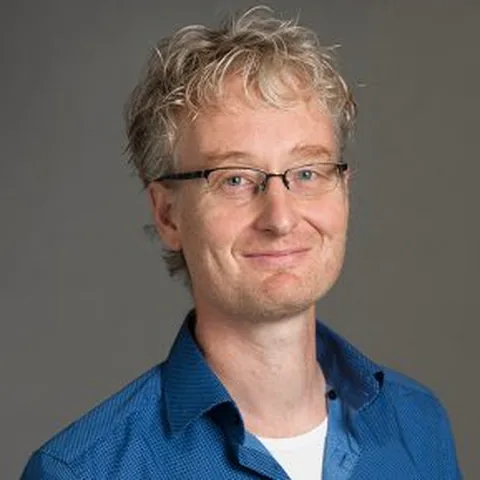
Photo: amlab.science.uva.nl; AMLab | Amsterdam Machine Learning Lab | Maxwelling; creator not stated. License: Not stated by source. Source: amlab.science.uva.nl. Cropped to a square and resized. Ask us to remove or replace this photo.
- Dr M. Welling, professor of Machine Learning - Universiteit van Amsterdam
- ICML Test Of Time Bayesian Learning via Stochastic Gradient Langevin Dynamics
- ICML 2011, The 28th International Conference on Machine Learning - Bellevue, Washington
- UvA-spin-off Scyfer overgenomen door Qualcomm Technologies, Inc. - Universiteit van Amsterdam
- ICLR 2024 Test of Time Award – ICLR Blog
- [1312.6114] Auto-Encoding Variational Bayes
- [1801.10130] Spherical CNNs
- CuspAI | AI-powered materials discovery
- Max Welling | European Laboratory for Learning and Intelligent Systems
- Max Welling appointed member of the KNAW - Informatics Institute - University of Amsterdam