Josh Levenberg
Also known as Joshua L. Levenberg
Josh Levenberg is a software engineer whose career spans video-game graphics, TensorFlow and programming-language design. He earned a mathematics degree at Reed College in 1994, built graphics and physics for games, and published a rendering paper in 2002. At Google, he coauthored TensorFlow system papers and a study of the company's monolithic code repository; his 2019 TensorFlow Eager paper describes a Python interface with immediate execution and graph tracing. As of October 2026, he is a Principal Engineer at Google, working on Carbon Language's type-system design.
Timeline
-
1994
Mathematics at Reed
He earns a B.A. in mathematics from Reed College in 1994. He holds a Ph.D. in mathematics from UC Berkeley.
-
1996–2000
Video game physics
In 1996, he rewrites graphics and adds pathfinding, sound compression, and scripting for Vampire: The Masquerade. He writes physics simulations for Brunswick Circuit Pro Bowling in 1997 and the physics engine for Flintstones Bedrock Bowling in 1998–1999; the game releases in late 2000.
-
2002
Cached-geometry rendering
In 2002, he publishes Fast View-Dependent Level-of-Detail Rendering Using Cached Geometry in IEEE Visualization.
-
2015
TensorFlow's machine-learning interface
In 2015, he coauthors TensorFlow: Large-Scale Machine Learning on Heterogeneous Distributed Systems, which describes an interface and implementation for machine-learning algorithms. The TensorFlow API and reference implementation are released as an open-source package in November 2015.
-
2016
TensorFlow at OSDI
In 2016, he presents TensorFlow at OSDI as a Google Brain speaker. The paper describes dataflow graphs that represent computation and shared state across machines and devices.
-
2016
Google's monolithic repository
With Rachel Potvin, he coauthors a 2016 Communications of the ACM article about Google's monolithic code repository, its scale, and the systems and workflows that support it.
-
2019
TensorFlow Eager
In 2019, he coauthors TensorFlow Eager, a Python-embedded DSL for hardware-accelerated machine learning. It executes TensorFlow operations immediately and uses a JIT tracer to turn Python functions into executable dataflow graphs.
-
As of October 2026
Carbon Language type design
He is a Principal Engineer at Google on the Carbon Language team, where he drives large parts of the language design across its type system.
Career
- NowGooglePrincipal Engineer
Education
- 1994Reed CollegeB.A. in mathematics
- University of California, BerkeleyPh.D. in mathematics
Videos
 Definition-Checked Generics, Part 2: The Why & How - Chandler Carruth, Josh Levenberg, Richard SmithCppNow · 25 August 2023 · 1 h 19 min
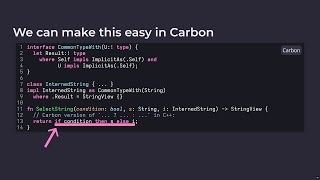 Definition-Checked Generics, Part 1: The Why & How - Chandler Carruth, Josh Levenberg, Richard SmithCppNow · 25 August 2023 · 1 h 29 min
 Inside TensorFlow: tf.distribute.StrategyTensorFlow · 15 August 2019 · 55 min
Video data from YouTube API Services. By watching you agree to the YouTube Terms of Service. How we use YouTube data.
Sources and credits
Photo: We have no published photo of Josh Levenberg yet. Send us a free-licensed photo.
- Josh Levenberg's Resume
- Josh Levenberg
- Fast View-Dependent Level-of-Detail Rendering Using Cached Geometry
- TensorFlow: Large-Scale Machine Learning on Heterogeneous Distributed Systems
- TensorFlow: A system for large-scale machine learning
- Josh Levenberg | USENIX
- Why Google Stores Billions of Lines of Code in a Single Repository
- TensorFlow Eager: A Multi-Stage, Python-Embedded DSL for Machine Learning
- Josh Levenberg : NDC TechTown