Alan Turing
Alan Turing was a British mathematician whose work helped establish the foundations of computing. At Cambridge and Princeton, he studied mathematical logic. His 1936 paper described a universal computing machine and showed that mechanical calculation has limits. During the Second World War, he contributed to the collective codebreaking effort at Bletchley Park. He later worked on electronic computers at the National Physical Laboratory and Manchester. In 1950, he proposed an imitation game to examine claims about machine intelligence. His later research also studied biological pattern formation. Turing was convicted for homosexual activity in 1952 and died in 1954. The British government announced a royal pardon in 2013.
- Works
- 82
Publication numbers from OpenAlex, as of 14 October 2026. Citations and h-index are hidden because this OpenAlex record may be incomplete or mix in other authors.
Timeline
-
1936
Defining a general computing machine
Described a universal computing machine and formal limits on mechanical calculation.
-
1939–1945
Joining the codebreaking effort
Contributed to the collective Enigma codebreaking effort at Bletchley Park.
-
1946–1948
Designing an electronic computer
Designed the Automatic Computing Engine and moved to Manchester in 1948.
-
1950
Asking about intelligence through conversation
Proposed the imitation game in Computing Machinery and Intelligence.
-
1952–2013
Persecution and later recognition
Was convicted in 1952 and died in 1954; the British government announced a royal pardon in December 2013.
Sources and credits
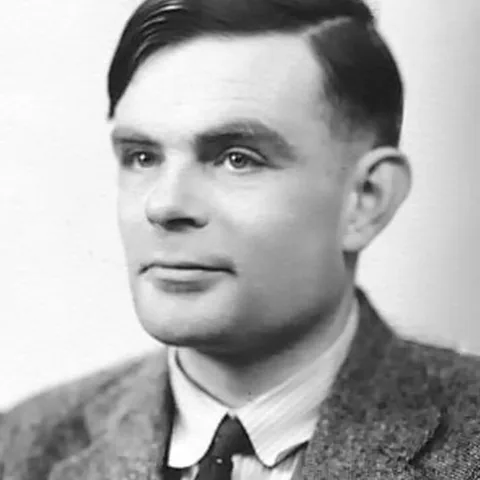
Photo: Elliott & Fry, via Wikimedia Commons. License: Public domain. Source: commons.wikimedia.org. Cropped to a square and resized. Ask us to remove or replace this photo.
_(crop).jpg)