Noam Shazeer
Noam Shazeer is a researcher and engineer whose work connects language-model design with the systems needed to train large models. He coauthored the 2017 sparse mixture-of-experts paper and the Transformer paper with their research teams. Later papers included Mesh-TensorFlow, T5, question answering from model parameters, and LaMDA. These projects address different parts of the same problem: how to build models that process language at scale. In 2022, he and Daniel de Freitas introduced Character.AI, with a founding team developing conversational characters. His early work was at Google.
- Now at
- Character.AI
- Works
- 58
Publication numbers from OpenAlex, as of 14 October 2026. Citations and h-index are hidden because this OpenAlex record may be incomplete or mix in other authors.
Timeline
-
Early Google work
Language in useful software
Shazeer recalls work on spelling suggestions and ad targeting.
-
2017
Experts and attention
He coauthors sparse mixture-of-experts research and the Transformer paper with separate research teams.
-
2018
Distributed model training
Mesh-TensorFlow distributes calculations across a mesh of processors.
-
2019–2020
Shared language tasks
The T5 team uses text-in, text-out tasks; Roberts, Raffel, and Shazeer also study closed-book question answering.
-
2022
Dialogue models
Shazeer is among LaMDA’s authors, studying dialogue quality, safety, and grounding.
-
2022
Character.AI
He and Daniel de Freitas introduce Character.AI after its September public beta.
Sources and credits
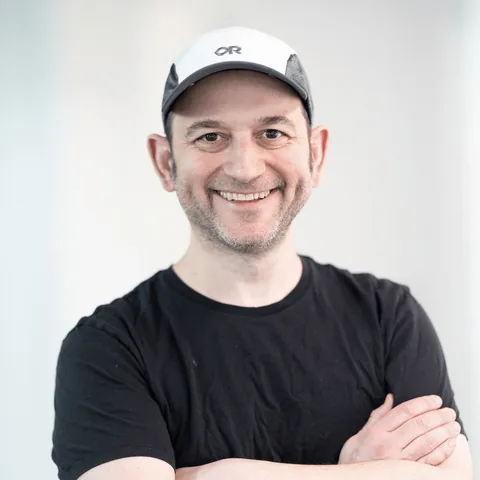
Photo: Axios HQ event speaker profile. License: Not stated by source. Source: axioshq.com. Cropped to a square and resized. Ask us to remove or replace this photo.
- Shazeer, de Freitas and team: Introducing Character, 2022
- Shazeer and colleagues: sparse mixture of experts, 2017
- Vaswani and colleagues: Attention Is All You Need, 2017
- Shazeer and colleagues: Mesh-TensorFlow, 2018
- Raffel and colleagues: T5, 2019
- Roberts, Raffel and Shazeer: model knowledge, 2020
- Thoppilan and colleagues: LaMDA, 2022