Rachel Thomas
Also known as fast.ai, data ethics
Rachel Thomas co-founded fast.ai and helped teach its early practical deep learning course. She has a mathematics doctorate from Duke and earlier experience in data science, software, and teaching. Her later work at the University of San Francisco included technical courses and the Center for Applied Data Ethics. With David Uminsky, she wrote about the problems caused by optimising metrics without sufficient attention to wider effects. Thomas left AI in 2023 to study microbiology and immunology. In August 2026, she described returning through education work with Answer.AI. Her public voice connects accessible technical learning with ethics, evidence, and the continued use of human judgement.
- Now at
- Answer.AI
Timeline
-
Before fast.ai
Mathematics and software work
Thomas earned a mathematics doctorate at Duke. Before her public AI teaching, she worked as a quantitative analyst, Uber data scientist, backend engineer and instructor.
-
October 2016
Co-founding practical deep learning teaching
Thomas introduced herself to the fast.ai course community as a co-founder and assistant instructor. Her interests include medicine, social good, education and diversity. The course gave her a public route to help people with different backgrounds apply deep learning to their own problems.
-
Later teaching and ethics work
Creating space for data ethics
She taught natural language processing and linear algebra at the University of San Francisco. She was the founding director of its Center for Applied Data Ethics. This work placed questions about social effects alongside the technical training given to data science students.
-
2020
Examining the limits of metrics
Thomas and David Uminsky published The Problem with Metrics Is a Fundamental Problem for AI. They described how optimising a numerical target can encourage gaming and overlook wider effects.
-
2023–2025
Moving into biological science
In her August 2026 account, Thomas said she left AI in 2023 to earn an MS in microbiology-immunology. She later wrote about AI and medicine. That work connected technical promises with the quality and gaps of evidence used in scientific and medical systems.
-
August 2026
Returning through AI education
Thomas joined Answer.AI to focus on education. She discusses using AI while keeping critical thinking and human judgement central.
Sources and credits
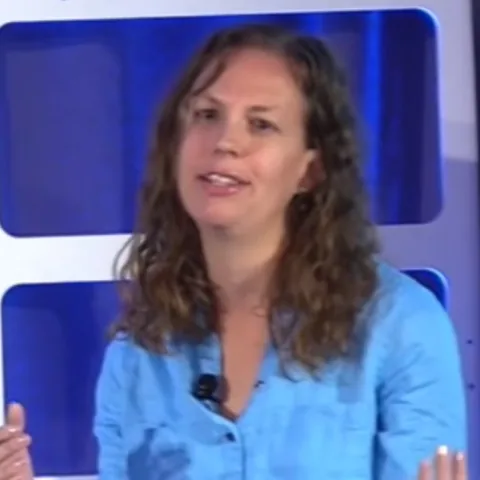
Photo: The Linux Foundation, via Wikimedia Commons. License: CC BY 3.0. Source: commons.wikimedia.org. Cropped to a square and resized. Ask us to remove or replace this photo.
