John Langford
Also known as J. Connor Langford, J. Langford, John C. Langford
John Langford is a machine learning researcher whose work connects learning theory, online learning systems, and contextual-bandit recommendation. He studies physics and computer science at Caltech, earns graduate degrees in computer science at Carnegie Mellon, and moves through research roles at IBM, Toyota Technological Institute at Chicago, Yahoo Research and Microsoft Research. At Yahoo, he develops Vowpal Wabbit and coauthors a contextual-bandit method for personalized news recommendation. His research projects include Isomap, CAPTCHA, learning reductions, and Cover Trees; in 2025 he presents belief-state transformers for goal-conditioned planning. His 2026 coauthored work covers transformers and language models, and as of October 2026 he is a Partner Researcher Manager at Microsoft Research.
- Now at
- Microsoft Research
- Works
- 214
- Citations
- 34,952
- h-index
- 62
Publication numbers from OpenAlex, as of 14 October 2026.
Timeline
-
1997–2002
From physics to learning theory
He earns bachelor's degrees in physics and computer science at Caltech in 1997, an MS in computer science in 2000, and a PhD in 2002 at Carnegie Mellon. His thesis focuses on tight sample-complexity bounds for evaluating and designing learning algorithms.
-
2002–2006
From IBM to Chicago
He is a Herman Goldstine Fellow at IBM's Watson Research Center from 2002 to 2003, then a research assistant professor at Toyota Technological Institute's Chicago campus from 2003 to 2006.
-
2006–2012
A system for online learning
At Yahoo! Research, he works as a senior research scientist and develops Vowpal Wabbit. The system begins there as a 2007 internal contest project and grows into an open-source tool for online interactive learning. In 2010, he coauthors a contextual-bandit approach to personalized news recommendation.
-
2012
Finding a base at Microsoft
He joins Microsoft Research in May 2012. His research projects include Isomap, CAPTCHA, learning reductions, Cover Trees, and contextual-bandit learning.
-
2012–2022
Guiding the ICML community
He serves as program chair for ICML in 2012 and general chair in 2016. From 2020 to 2022, he is the conference's Pandemic President.
-
February 2025
Belief states for planning
He presents a transformer architecture that generates compact belief states for goal-conditioned planning. The architecture aims to improve planning algorithms, and its paper is accepted at ICLR.
-
2026
New directions for transformers
His 2026 coauthored work includes Full-bandwidth transformer, Hierarchical Latent Prediction for Language Models, and MEMENTO: Teaching LLMs to Manage Their Own Context.
-
As of October 2026
A current role in research
He is a Partner Researcher Manager at Microsoft Research.
Sources and credits
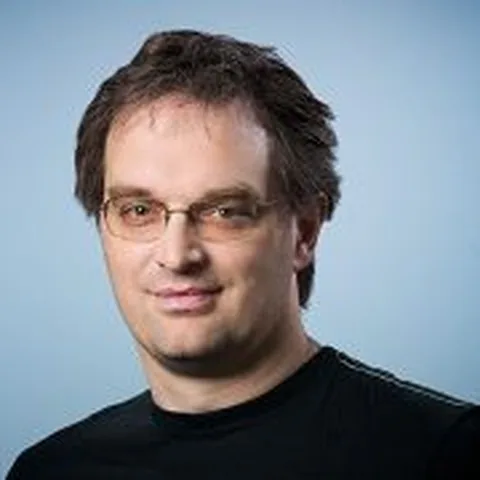
Photo: microsoft.com; John Langford at Microsoft Research; creator not stated. License: Not stated by source. Source: microsoft.com. Cropped to a square and resized. Ask us to remove or replace this photo.