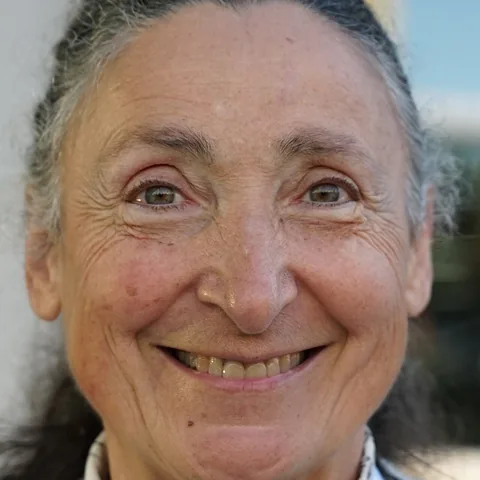
Isabelle Guyon
Isabelle Guyon helped develop the support vector machine, a method for classifying data. After studying in Paris, she met Vladimir Vapnik during postdoctoral research in 1991; their work led to the SVM. Her research also covers feature selection and machine-learning challenges, including a JMLR article with André Elisseeff and the NIPS 2003 feature-selection competition. At Université Paris-Saclay, she taught and advised graduate students, coordinated its AI master's program, and served as a NeurIPS co-chair. She shared the 2019 BBVA Foundation Frontiers of Knowledge Award with Vapnik and Bernhard Schölkopf, and as of October 2026 she is a Director and Research Scientist at Google DeepMind, where she studies AI self-improvement and AI use in peer review, and president of ChaLearn.
- Now at
- Google DeepMind and ChaLearn
- Works
- 440
- Citations
- 50,086
- h-index
- 68
Publication numbers from OpenAlex, as of 14 October 2026.
Timeline
-
1988
A doctorate in Paris
She graduates from the École Supérieure de Physique et Chimie Industrielles in Paris, then earns a PhD in Physical Sciences at Université Pierre et Marie Curie in 1988.
-
1991
Developing a support vector machine
During postdoctoral research, she meets Vladimir Vapnik in 1991; together they develop the support vector machine for data classification. She works at Bell Labs for seven years and later moves to Berkeley.
-
1996–2011
Machine learning challenges
She creates the Coplinet consultancy in 1996, then founds ChaLearn in 2011 to teach machine learning through challenges that attract thousands of entrants.
-
2003
Selecting useful features
With André Elisseeff, she publishes the JMLR article “An Introduction to Variable and Feature Selection.” It presents variable selection as a way to improve prediction, make predictors faster and more cost-effective, and clarify the process that generated the data.
-
2003
Testing feature selection
With Steve Gunn, Asa Ben-Hur, and Gideon Dror, she organizes the NIPS 2003 feature-selection competition. It gives participants five data sets and attracts 78 research groups.
-
2015–2025
Teaching and chairing NeurIPS
She taught machine learning and advised graduate students at Université Paris-Saclay. From 2019 to 2021, she coordinated its CS Artificial Intelligence master's program; she served as NeurIPS co-program chair in 2016 and co-general chair in 2017.
-
2019
Recognition for machine learning
She shared the BBVA Foundation Frontiers of Knowledge Award in Information and Communications Technology with Bernhard Schölkopf and Vladimir Vapnik for their fundamental contributions to machine learning.
-
As of October 2026
Research at Google DeepMind
She is a Director and Research Scientist at Google DeepMind, where she studies AI self-improvement and AI use in peer review. In 2026, she is president of ChaLearn.
Sources and credits
Photo: Xuthoria, via Wikimedia Commons. License: CC BY-SA 4.0. Source: commons.wikimedia.org. Cropped to a square and resized. Ask us to remove or replace this photo.
.jpg)
- Isabelle Guyon,12th Frontiers of Knowledge Award in Information and Communication Technologies
- Isabelle Guyon
- An Introduction to Variable and Feature Selection
- Result Analysis of the NIPS 2003 Feature Selection Challenge
- Galardonados categorías - Premios Fronteras
- Contact us - Challenges in Machine Learning