Daniela Rus
Daniela Rus develops robotics and autonomy, including shared work on reconfigurable robots and distributed robot systems. Rus earned a computer science and mathematics degree from Iowa in 1985, a master’s from Cornell in 1990 and a doctorate from Cornell in August 1992. Her doctoral thesis concerned fine motion planning for dexterous manipulation, supervised by John Hopcroft. Her research addresses autonomy, interfaces between people and robots, and tools to design and fabricate robots. Her research aims to develop reasoning, learning and adaptation to complex tasks. The applications range across transportation, environmental work and medicine; not all are deployed systems.
- Works
- 1,123
- Citations
- 67,946
- h-index
- 128
Publication numbers from OpenAlex, as of 14 October 2026.
Timeline
-
1985–1992
Training in computing and manipulation
Rus earned a computer science and mathematics degree from Iowa in 1985, a master’s from Cornell in 1990 and a doctorate from Cornell in August 1992. Her doctoral thesis concerned fine motion planning for dexterous manipulation, supervised by John Hopcroft.
-
1994–2004
Robotics at Dartmouth and MIT
She was an assistant professor at Dartmouth from 1994 to 2000 and an associate professor from 2000 to 2003. She became a Dartmouth professor in 2003 and an MIT associate professor in 2004. Her teaching included AI and robot design, programming and algorithms.
-
2003–2004
Modular robots and sensor networks
Rus and Zachary Butler published shared research on distributed planning and control for modular robots in 2003. With Butler, Keith Kotay and Kohji Tomita, she published work on decentralized locomotion control in 2004. She also researched robots and sensor networks with Vijay Kumar and Sanjiv Singh.
-
As of October 2026
Designing machines for human environments
Her research addresses autonomy, interfaces between people and robots, and tools to design and fabricate robots. Her research aims to develop reasoning, learning and adaptation to complex tasks. The applications range across transportation, environmental work and medicine; not all are deployed systems.
Sources and credits
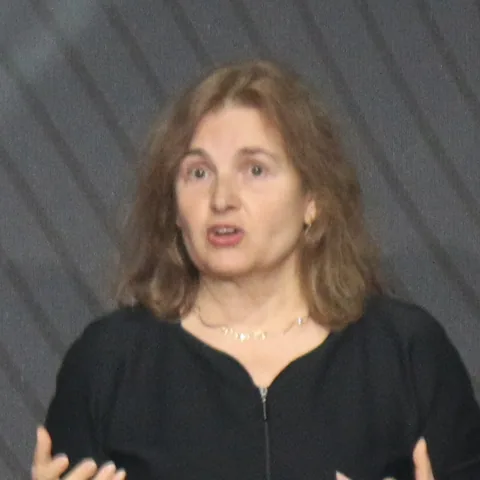
Photo: Xuthoria, via Wikimedia Commons. License: CC BY-SA 4.0. Source: commons.wikimedia.org. Cropped to a square and resized. Ask us to remove or replace this photo.
_2.jpg)