Abeba Birhane
Abeba Birhane is a cognitive scientist whose AI research examines the social effects of datasets and computational models. She earned an MA in Cognitive Science in 2015 and a PhD in 2022 at University College Dublin. Her 2020 study contributed to MIT's decision to remove the 80 Million Tiny Images dataset, and a 2023 co-authored study found more hateful content and stronger stereotypes as datasets scaled. After her Mozilla Trustworthy AI fellowship, she was named to TIME100 AI and joined the UN Secretary-General's High-level Advisory Body on AI. At Trinity College Dublin, she leads the AI Accountability Lab and is an Assistant Professor in Computer Science.
- Now at
- Trinity College Dublin
- Works
- 66
- Citations
- 4,675
- h-index
- 27
Publication numbers from OpenAlex, as of 14 October 2026.
Timeline
-
2015–2022
A doctorate across disciplines
At University College Dublin, she earns an MA in Cognitive Science in 2015 and completes a PhD in 2022. Her thesis, Automating Ambiguity, connects cognitive science with audits of large AI datasets and the limits of machine prediction.
-
2020–2021
Auditing labels and ethics
She and Vinay Prabhu report racist and misogynistic labels in the 80 Million Tiny Images dataset; MIT removes the collection after their findings. Her 2021 paper, Algorithmic injustice: a relational ethics approach, argues for relational ways to think about personhood, data and justice.
-
May 2023
A Mozilla fellowship
Her 15-month Mozilla fellowship in Trustworthy AI concludes in May 2023. During it, she studies training datasets and audits saliency-cropping algorithms used by Twitter, Apple, and Google.
-
June 2023
Measuring data scale
In On Hate Scaling Laws For Data-Swamps, she and three co-authors compare LAION-400M and LAION-2B-en. The audit reports increased hateful content and stronger societal biases and negative stereotypes as dataset scale grows.
-
September 2023
TIME100 AI recognition
TIME names her to its inaugural TIME100 AI list in September 2023. At the time, she is a Senior Advisor in AI Accountability at Mozilla Foundation and an Adjunct Assistant Professor at Trinity College Dublin.
-
October 2023
Joining the UN advisory body
She joins the UN Secretary-General’s AI Advisory Body as a member. The body is created to assess risks and opportunities and support international AI governance.
-
November 2024–September 2025
A lab for accountability
Trinity launches her AI Accountability Lab in November 2024 to audit models and training datasets and examine opaque technology ecologies. By September 2025, she is the lab's director.
-
As of October 2026
Leading AI accountability
She directs the AI Accountability Lab and is an Assistant Professor in Computer Science at Trinity College Dublin. Her research focuses on AI accountability, governance structures, and algorithmic audits.
Sources and credits
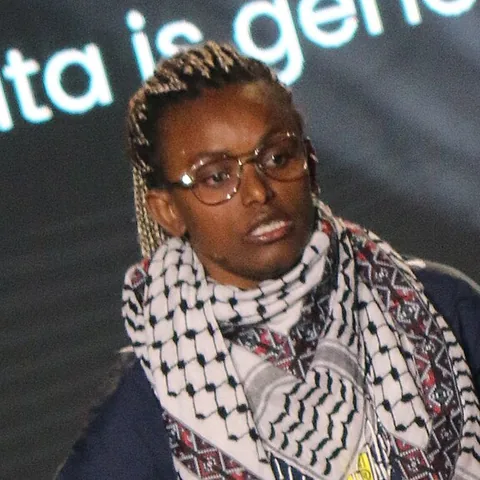
Photo: Xuthoria, via Wikimedia Commons. License: CC BY-SA 4.0. Source: commons.wikimedia.org. Cropped to a square and resized. Ask us to remove or replace this photo.
.jpg)
- Technology Class Acts - UCD Connections
- Automating Ambiguity: Challenges and Pitfalls of Artificial Intelligence
- Lero researcher finds racist and misogynistic terms in image library used to inform AI
- Algorithmic injustice: a relational ethics approach - PMC
- Dr. Abeba Birhane: Advocating For AI That Centers Marginalized Groups - Mozilla Foundation
- On Hate Scaling Laws For Data-Swamps
- Professor Abeba Birhane named to TIME’s inaugural TIME100 AI list - School of Computer Science and Statistics | Trinity College Dublin
- UN Secretary-General launches AI Advisory Body on risks, opportunities, and international governance of artificial intelligence | United Nations in India
- Trinity establishes AI Accountability Lab - News & Events | Trinity College Dublin
- Dr Abeba Birhane joins world leaders at AI summit at the Vatican - News & Events | Trinity College Dublin
- BIRHANEA - School of Computer Science and Statistics | Trinity College Dublin