Zeb Kurth-Nelson
Zeb Kurth-Nelson studies connections between neuroscience and artificial intelligence. He coauthored work treating the prefrontal cortex as a meta-reinforcement learning system and later research connecting distributional reinforcement learning with dopamine signals. With collaborators, he proposed that memory replay can assemble familiar elements into new knowledge. He also works on AI alignment and boundaries around optimization. Theories about brain mechanisms remain hypotheses with specific experimental support and tests.
- Now at
- Google DeepMind and University College London
- Works
- 108
- Citations
- 7,518
- h-index
- 36
Publication numbers from OpenAlex, as of 14 October 2026.
Timeline
-
2018
Learning how to learn
At DeepMind, with Jane Wang and Matt Botvinick, Kurth-Nelson studied a recurrent network trained with reinforcement learning. They compared the network with neuroscience experiments to test a theory of rapid learning in the prefrontal cortex.
-
2020
Many predictions of future reward
Kurth-Nelson and Will Dabney studied links between distributional reinforcement learning and dopamine. The work explores how a range of optimistic and pessimistic reward predictions can explain recorded neural responses. It establishes a proposed link between AI and neuroscience.
-
2022
Replay and new combinations
He coauthored Replay and compositional computation. The paper proposes that replay can combine objects and relationships to derive new knowledge. It suggests experiments and discusses implications for AI systems that struggle to generalize to unfamiliar problems.
-
2023–2025
Study alignment boundaries
He studies semi-permeable boundaries around optimization as an AI-alignment theme. His papers on the topic span 2023 through 2025.
Sources and credits
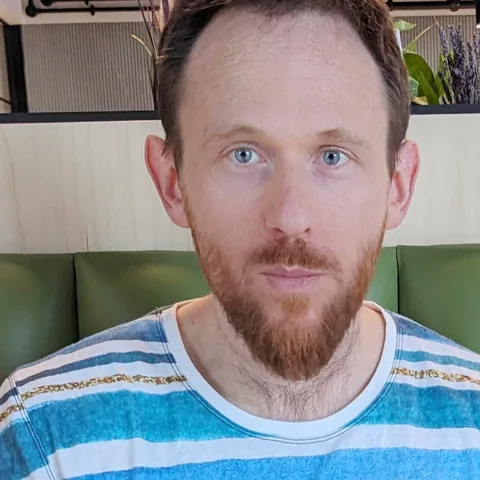
Photo: zebk.com; creator not stated. License: Not stated by source. Source: zebk.com. Cropped to a square and resized. Ask us to remove or replace this photo.