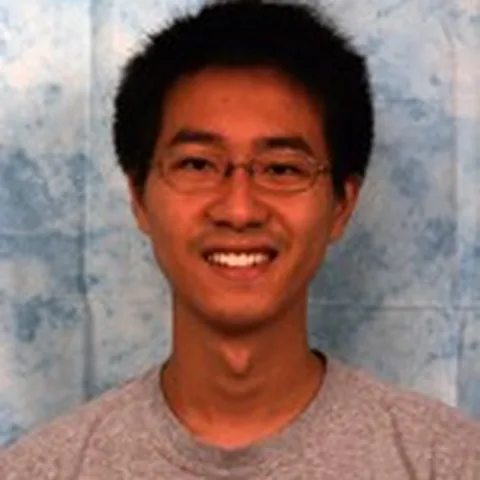
Siyuan Feng
Siyuan Feng researches robot control and learning. He earned a robotics PhD in February 2016 and served as control lead for Team WPI-CMU in the DARPA Robotics Challenge. In 2022, he coauthored Iterative Residual Policy for manipulating deformable objects while affiliated with Toyota Research Institute. He later coauthored Diffusion Policy, first submitted in March 2023, which uses denoising diffusion to generate robot actions from visual observations.
- Works
- 90
- Citations
- 3,208
- h-index
- 24
Publication numbers from OpenAlex, as of 14 October 2026.
Timeline
-
2012–2016
Control for humanoid robots
Feng worked on full-body humanoid control beginning in 2012 and served as control lead for Team WPI-CMU in the DARPA Robotics Challenge. He completed a CMU robotics PhD in February 2016 on online hierarchical optimization for humanoid control.
-
2022
Learning from action changes
Feng coauthored Iterative Residual Policy with a team from Columbia and Toyota Research Institute. The method learns how changes in an action affect a previously observed trajectory. It then adjusts actions online to reach a specified manipulation goal.
-
2022
Testing ropes and cloth
The team tested the policy by whipping a rope toward a target and swinging cloth toward a target pose. The policy transferred from simulation to real dynamics and new objects. Feng was affiliated with Toyota Research Institute at the time.
-
2023
Diffusion for robot actions
He coauthored Diffusion Policy, initially submitted in March 2023. The method represents a robot’s visuomotor policy as a conditional denoising process. The expanded paper describes visual conditioning and repeated planning over an action sequence.
Sources and credits
Photo: www.cs.cmu.edu; Siyuan Feng profile photograph; creator not stated. License: Not stated by source. Source: cs.cmu.edu. Cropped to a square and resized. Ask us to remove or replace this photo.