Roger Shepard
Also known as Roger Newland Shepard
Roger Shepard was a cognitive scientist who became convinced that generalization is the most fundamental problem confronting learning theory. At Bell Labs he developed nonmetric multidimensional scaling, a mathematical method for mapping subjective data, such as how people perceive shapes. His universal law of generalization, proposed in a 1987 paper, ties the chance that a response to one stimulus generalizes to another to the distance between the stimuli in a psychological space. With Jacqueline Metzler he was among the first to research mental rotation in 1971, and he received the National Medal of Science in 1995 and the Rumelhart Prize in 2006. He died in 2022 at age 93.
- Works
- 125
- Citations
- 31,963
- h-index
- 57
Publication numbers from OpenAlex, as of 14 October 2026.
Timeline
-
1951–1955
Stanford and Yale training
He earns a Stanford bachelor's degree in 1951 and a Yale PhD in 1955. He becomes convinced that generalization is the most fundamental problem confronting learning theory.
-
1958–1968
Bell Labs, then Stanford
He joins Bell Labs in 1958, where computer facilities let him expand earlier work on generalization. He returns to Stanford in 1968, where he serves on the faculty for over 30 years.
-
1962
Nonmetric multidimensional scaling
His 1962 papers are the first on nonmetric multidimensional scaling, which he develops at Bell Labs. It is a mathematical method for mapping subjective data, such as how people perceive shapes.
-
1971
Mental rotation studies
Together with Jacqueline Metzler, he is among the first to research mental rotation in 1971. A dream about rotating three-dimensional objects inspires the series, which establishes that people can conceive of such an object and rotate it.
-
1987
The universal law of generalization
His 1987 paper proposes the universal law of generalization. The law holds that the chance a response to one stimulus generalizes to another depends on the distance between the two stimuli in a psychological space.
-
1995
The National Medal of Science
In 1995 he receives the National Medal of Science, the highest scientific award in the United States.
-
2006
The Rumelhart Prize
Work on nonmetric scaling, the universal law of generalization and mental rotation earns him the Rumelhart Prize in 2006.
-
2022
Death at age 93
He dies in 2022 at age 93, as a cognitive scientist and professor emeritus of psychology at Stanford.
Sources and credits
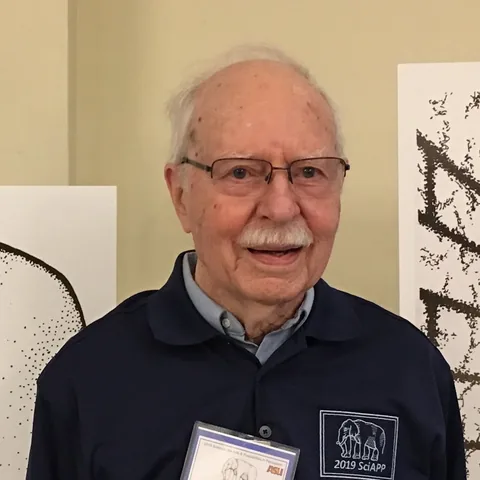
Photo: HouseOfChange, via Wikimedia Commons. License: CC BY-SA 4.0. Source: commons.wikimedia.org. Cropped to a square and resized. Ask us to remove or replace this photo.
