Leonidas Guibas
Also known as Leo Guibas, Λεωνίδας Γκίμπας
Leonidas Guibas is a Stanford professor who co-developed PointNet, a neural network that directly consumes raw point clouds. Earlier, he earned mathematics degrees at Caltech and a Stanford computer science PhD under Donald Knuth. He then worked at Xerox PARC, DEC SRC and MIT before joining the Stanford faculty in 1984. ACM and AAAI honored him with the Allen Newell Award in 2007. As of October 2026, he heads the Geometric Computation group in Stanford's Computer Science Department.
- Now at
- Stanford University and Department of Computer Science, Stanford University
- Works
- 1,115
- Citations
- 97,346
- h-index
- 128
Publication numbers from OpenAlex, as of 14 October 2026.
Timeline
-
1971–1976
From Caltech to a Knuth PhD
He earns bachelor's and master's degrees in mathematics at Caltech in 1971. In 1976 he completes a Stanford PhD in computer science under Donald Knuth.
-
1976–1984
Industry labs before Stanford
Next come stints at Xerox PARC, DEC SRC and MIT.
-
Since 1984
A Stanford professorship
He joins the Stanford faculty in 1984 and later serves as acting director of the Stanford Artificial Intelligence Laboratory.
-
2007
An award for applying algorithms
ACM and AAAI honored him with the Allen Newell Award in 2007 for applying algorithms across computer science.
-
2017
Reading raw point clouds
With Charles R. Qi, Hao Su and others, he co-developed PointNet, a neural network that directly consumes raw point clouds.
-
2017–2022
Three national academies
He became a member of the National Academy of Engineering in 2017, the American Academy of Arts and Sciences in 2018 and the National Academy of Sciences in 2022.
-
As of October 2026
A Stanford research group
He is a professor at Stanford, where he heads the Geometric Computation group in the Computer Science Department.
Sources and credits
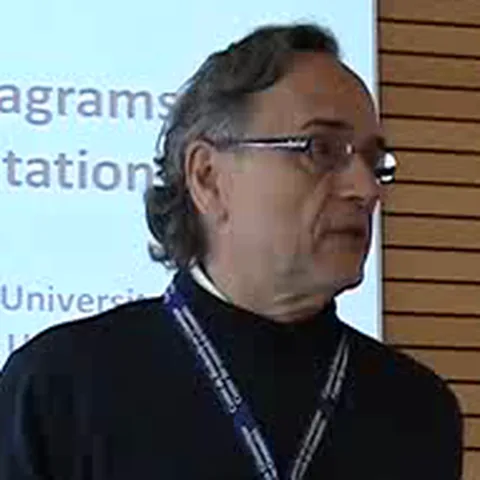
Photo: Sergio01, via Wikimedia Commons. License: CC BY-SA 3.0. Source: commons.wikimedia.org. Cropped to a square and resized. Ask us to remove or replace this photo.
