Jared Kaplan
Jared Kaplan coauthored papers on language-model scaling, GPT-3, and assistant alignment. He earned a bachelor's degree in physics and mathematics from Stanford, completed a physics Ph.D. at Harvard, worked as a postdoctoral fellow at SLAC and Stanford, and became a Johns Hopkins professor in 2012. He joined OpenAI in 2019 and coauthored the 2020 scaling-laws and GPT-3 papers; NeurIPS gave the GPT-3 paper an Outstanding Paper award. In 2021, he coauthored a paper that introduced Codex and co-founded Anthropic; his 2022 papers covered reinforcement learning from human feedback and Constitutional AI, and TIME included him in its 2025 TIME100 AI list. As of October 2026, he is Anthropic's Chief Science Officer and heads its technical research efforts on AI safety and development.
- Now at
- Johns Hopkins University and Anthropic
- Works
- 82
Publication numbers from OpenAlex, as of 14 October 2026. Citations and h-index are hidden because this OpenAlex record may be incomplete or mix in other authors.
Timeline
-
By 2012
From Stanford to Johns Hopkins
He earns a bachelor's degree in physics and mathematics from Stanford, completes a physics Ph.D. at Harvard, and works as a postdoctoral fellow at SLAC and Stanford. In 2012, he becomes a professor of physics at Johns Hopkins.
-
2019
Joining OpenAI
He joins OpenAI in 2019.
-
2020
Scaling laws for language models
In 2020, he coauthors “Scaling Laws for Neural Language Models,” which finds power-law links between language-model loss, model size, dataset size, and training compute.
-
2020
The NeurIPS Outstanding Paper
In 2020, he coauthors “Language Models are Few-Shot Learners,” which trains GPT-3 and tests its few-shot performance. The paper receives a NeurIPS Outstanding Paper award.
-
2021
Codex and Anthropic
In 2021, he coauthors “Evaluating Large Language Models Trained on Code,” which introduces Codex, a GPT model fine-tuned on publicly available GitHub code. He also co-founds Anthropic in 2021.
-
2022
Training helpful assistants
In 2022, he coauthors “Training a Helpful and Harmless Assistant with Reinforcement Learning from Human Feedback,” which applies preference modeling and RLHF to tune language models. He also coauthors “Constitutional AI: Harmlessness from AI Feedback,” which uses written principles to train a harmless assistant through self-improvement.
-
2025
A TIME100 AI listing
In 2025, he appears on the TIME100 AI list of influential people in artificial intelligence.
-
As of October 2026
Chief Science Officer at Anthropic
As of October 2026, he is Anthropic's co-founder and Chief Science Officer and heads its technical research efforts on AI safety and development.
Sources and credits
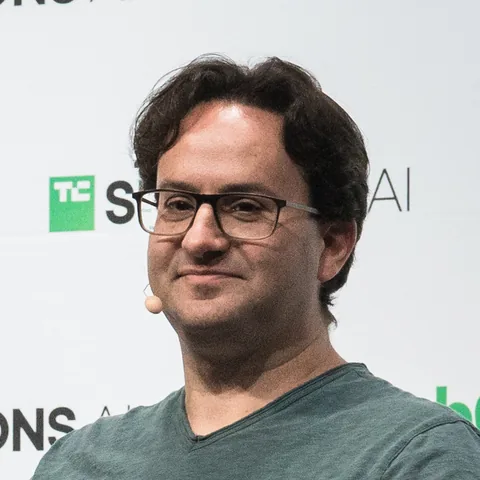
Photo: TechCrunch, via Wikimedia Commons. License: CC BY 2.0. Source: commons.wikimedia.org. Cropped to a square and resized. Ask us to remove or replace this photo.
.jpg)
- Jared Kaplan
- ‘The biggest decision yet’: Jared Kaplan on allowing AI to train itself
- [2001.08361] Scaling Laws for Neural Language Models
- NeurIPS 2020 Awards
- Open AI’s GPT-3 Paper Shares NeurIPS 2020 Best Paper Award With Works from Politecnico di Milano, CMU and UC Berkeley | Synced
- [2107.03374] Evaluating Large Language Models Trained on Code
- Training a Helpful and Harmless Assistant with Reinforcement Learning from Human Feedback
- [2212.08073] Constitutional AI: Harmlessness from AI feedback
- AI Leaders Talk How AI Can Transform Business at TIME100 Impact Dinner
- Leadership at Anthropic