Hartmut Neven
Hartmut Neven is a researcher whose work connects machine learning with quantum computing. He earned a robotics Ph.D. in 1996, later became a research professor at USC, and started computer-vision companies; Google acquired Neven Vision in 2006. At Google, he co-founded Project Glass and Quantum AI, and his teams moved from early quantum image-recognition algorithms to visual-recognition competitions and the Sycamore and Willow processors. In 2026, his group expanded its research to neutral-atom computing.
Timeline
-
1996
A robotics doctorate
He earns a Ph.D. with a thesis on dynamics for vision-guided autonomous mobile robots, then becomes a research professor in computer science and theoretical neuroscience at the University of Southern California.
-
2006
A vision company joins Google
Before joining Google, he starts two computer-vision companies. Google acquires the second, Neven Vision, in 2006; it launches face login, face filters and visual search for mobile phones.
-
2007–2008
Learning on quantum hardware
He implements the first machine-learning and image-recognition algorithms on a quantum computer in 2007. A 2008 paper with Geordie Rose and William G. Macready formulates image recognition as a QUBO problem for D-Wave adiabatic processors.
-
2011–2012
From Glass to Quantum AI
At Google, he co-founds Project Glass, and his team builds its first prototype in 2011. He founds Google Quantum AI in 2012.
-
2014
A win at ImageNet
His teams win visual-recognition competitions in face, object and text recognition, including ImageNet for objects in 2014.
-
2019
A Sycamore milestone
Google's Sycamore chip completes a computation in 200 seconds that would take the world's fastest supercomputer 10,000 years.
-
December 2024
Willow works below threshold
Willow reaches below-threshold surface-code error correction, a milestone in a challenge pursued for almost 30 years.
-
March 2026
Adding neutral atoms
He announces Google Quantum AI's expansion into neutral-atom quantum computing alongside superconducting research.
Sources and credits
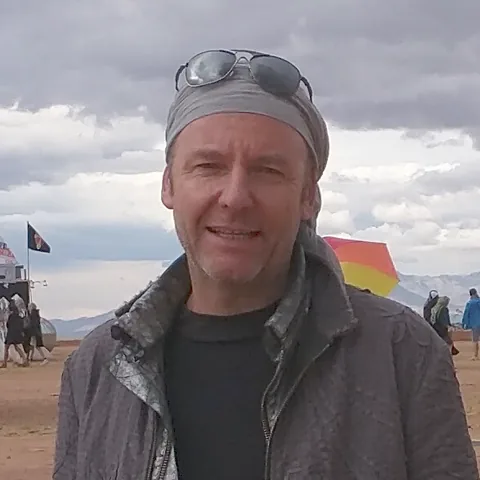
Photo: Quantum Computing Guy, via Wikimedia Commons. License: CC BY-SA 4.0. Source: commons.wikimedia.org. Cropped to a square and resized. Ask us to remove or replace this photo.

- Hartmut Neven
- Hartmut Neven Profile Page
- [0804.4457] Image recognition with an adiabatic quantum computer I. Mapping to quadratic unconstrained binary optimization
- Meet Willow, our state-of-the-art quantum chip
- Computing takes a quantum leap forward
- Quantum error correction below the surface code threshold
- Google Quantum AI to include neutral atom computing