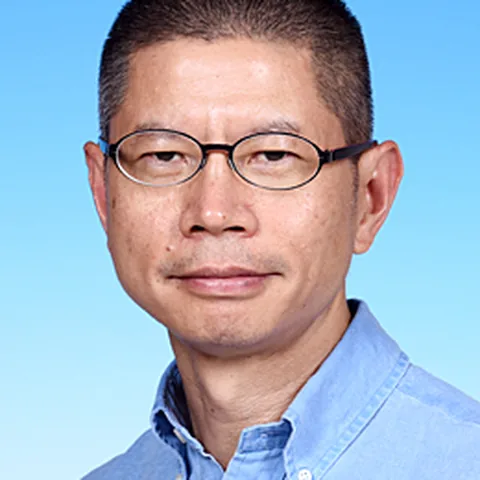
Fangzhen Lin
Fangzhen Lin studies logical representation and automated reasoning, including action languages, answer sets and planning. Lin earned a bachelor’s degree from Fuzhou in 1983, a master’s from Beijing University in 1986 and a Stanford doctorate in 1991. He conducted research at Stanford in 1991–1992 and Toronto in 1992–1996. His research centers on representation, reasoning and learning. Lin and Pingzhong Tang published computer-aided proofs of Arrow’s and other impossibility theorems at AAAI in 2008 and in Artificial Intelligence in 2009. This shared work connects automated reasoning to social choice theory. His research also includes game theory and multiagent systems.
- Works
- 163
- Citations
- 4,030
- h-index
- 27
Publication numbers from OpenAlex, as of 14 October 2026.
Timeline
-
1983–1996
Education and research positions
Lin earned a bachelor’s degree from Fuzhou in 1983, a master’s from Beijing University in 1986 and a Stanford doctorate in 1991. He held Stanford research roles in 1991–1992 and Toronto research work in 1992–1996. His research centers on representation, reasoning and learning.
-
1997
Logic for dynamic domains
Lin coauthored the GOLOG paper with Hector Levesque, Raymond Reiter, Yves Lespérance and Richard Scherl. The publication concerned a logic programming language for dynamic domains. With Reiter, he also published work on progressing a database.
-
2000–2004
Planning and answer sets
System R was a distinguished planner in the AIPS 2000 competition. With Yuting Zhao, he published ASSAT, a method for computing answer sets using satisfiability solvers, in 2004. An erratum addresses the paper’s loop definition.
-
2008–2009
Computer-assisted reasoning in social choice
Lin and Pingzhong Tang published computer-aided proofs of Arrow’s and other impossibility theorems at AAAI in 2008 and in Artificial Intelligence in 2009. This shared work connects automated reasoning to social choice theory. His research also includes game theory and multiagent systems.
Sources and credits
Photo: seng.hkust.edu.hk; Fangzhen LIN 林方真 | HKUST School of Engineering; creator not stated. License: Not stated by source. Source: seng.hkust.edu.hk. Cropped to a square and resized. Ask us to remove or replace this photo.