Edward A. Feigenbaum
Edward A. Feigenbaum developed knowledge-based AI through shared research on scientific inference, expert systems and medical applications. Feigenbaum earned an electrical engineering degree at Carnegie Institute of Technology in 1956 and a doctorate in industrial administration in 1960. He held Berkeley appointments from 1960 to 1965 and Stanford appointments beginning in 1965. He also coedited Computers and Thought with Julian Feldman in 1963. Feigenbaum, Robert Lindsay, Buchanan and Joshua Lederberg coauthored a 1980 book on AI for organic chemistry through DENDRAL. The same researchers published a 1993 case study. Feigenbaum and Buchanan also wrote a 1993 account of DENDRAL and Meta-DENDRAL as roots of knowledge systems.
- Works
- 186
- Citations
- 11,986
- h-index
- 44
Publication numbers from OpenAlex, as of 14 October 2026.
Timeline
-
1956–1965
Education and university research
Feigenbaum earned an electrical engineering degree at Carnegie Institute of Technology in 1956 and a doctorate in industrial administration in 1960. He held Berkeley appointments from 1960 to 1965 and Stanford appointments beginning in 1965. He also coedited Computers and Thought with Julian Feldman in 1963.
-
1972–1976
Learning rules for scientific inference
He coauthored papers with Bruce Buchanan and others on data interpretation and heuristic theory formation. A 1976 paper studied automatic rule formation in mass spectrometry through Meta-DENDRAL.
-
1978–1992
A computing resource for medical AI
Feigenbaum served as a co-principal investigator and later principal investigator of SUMEX-AIM. SUMEX-AIM was a national computer resource for applications of AI to medicine and biology. His Stanford department chair period, 1976 to 1981, partly overlapped this responsibility.
-
1980–1993
DENDRAL publications
Feigenbaum, Robert Lindsay, Buchanan and Joshua Lederberg coauthored a 1980 book on AI for organic chemistry through DENDRAL. The group published a 1993 case study. Feigenbaum and Buchanan also wrote a 1993 account of DENDRAL and Meta-DENDRAL as roots of knowledge systems.
Sources and credits
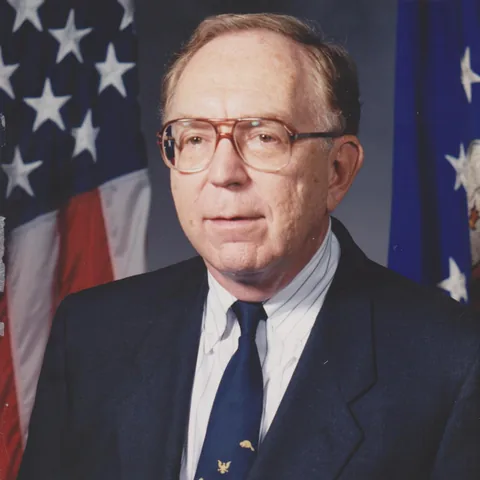
Photo: United States Air Force, via Wikimedia Commons. License: Public domain. Source: commons.wikimedia.org. Cropped to a square and resized. Ask us to remove or replace this photo.
